Sheet 21 · Best Places to Visit in England · 34 min read
Best Places to Visit in England: 25 Places for Your Trip
Discover the best places to visit in England, from London and Bath to the Cotswolds, York, Cornwall, the Lake District, and underrated northern escapes.
 Sheet 21
Contents 32 sections
If you are trying to choose the best places to visit in England, the first thing I would say is this: do not let the map trick you. England looks tidy and compact, and in one sense it is. You can cross from London to York by train in about two hours, reach Bath in under ninety minutes, and turn a London trip into a proper country-and-coast holiday without changing countries. But once you start adding villages, national parks, beaches, castles, gardens, cathedrals, football cities, literary towns, and old fishing harbors, England becomes very easy to overpack.
That is where a good destination list should do more than inspire you. It should help you make choices.
I have written this guide as a practical pillar for planning, not just a pretty list. Some places here are obvious because they deserve to be obvious: London, Bath, York, the Lake District, Cornwall, Oxford, Cambridge, Stonehenge, and the Cotswolds. Others earn their place because they round out an England trip beautifully: Durham, Chester, Northumberland, Norfolk, the Peak District, Bristol, the New Forest, and the North York Moors. The right mix depends on how much time you have, whether you want trains or a car, and whether your version of England is more museums and theatre, windswept cliffs, honey-stone villages, walking boots, Roman walls, or seafood on a harbor wall.
For a first trip, I would not try to see all 25. I would choose one strong city base, one heritage stop, one countryside or coast region, and one place that feels personal rather than obligatory. If you want a complete route, start with the England trip planner. If you are still deciding what kind of trip this should be, this guide is the place to begin.
Quick Answer: The Best Places To Visit In England
For first-time visitors, the best places to visit in England are London, Bath, Oxford or Cambridge, the Cotswolds, York, the Lake District, Cornwall, Stonehenge and Salisbury, Brighton and the Seven Sisters, and the Peak District. Those destinations give you a balanced first trip: capital city energy, Roman and medieval history, university architecture, villages, dramatic countryside, coast, and at least one ancient landmark.
If you have only one week, choose London plus two or three nearby or rail-friendly places: Bath, Oxford, Cambridge, Windsor, Brighton, Canterbury, or York. If you have ten to fourteen days, add a deeper countryside or coastal region such as the Cotswolds, Lake District, Cornwall, Devon, Dorset, Yorkshire, or Northumberland. If you have three weeks or more, England becomes much more rewarding because you can slow down and stop treating every destination as a box to tick.
Here is the short version before we get into the detail.
| Destination | Best For | Minimum Time | Easiest Transport | Pair It With |
|---|---|---|---|---|
| London | First timers, museums, theatre, food, landmarks | 3-5 days | Train, Tube, walking | Windsor, Oxford, Cambridge, Brighton |
| Bath | Roman history, Georgian streets, elegant city breaks | 1-2 days | Train | Stonehenge, Cotswolds, Bristol |
| Oxford | Colleges, libraries, pubs, literary atmosphere | 1 day | Train | Cotswolds, Blenheim Palace |
| Cambridge | Colleges, punting, compact beauty | 1 day | Train | Ely, East Anglia |
| Cotswolds | Villages, walks, countryside stays | 2-4 days | Car or tour | Bath, Oxford, Stratford |
| York | Medieval streets, walls, museums, rail-friendly history | 2 days | Train | Yorkshire Dales, North York Moors |
| Lake District | Mountains, lakes, walking, scenery | 3-5 days | Train plus bus, or car | Yorkshire, Manchester, Liverpool |
| Cornwall | Beaches, cliffs, seafood, road trips | 4-7 days | Car best | Devon, Dorset |
| Stonehenge and Salisbury | Ancient England, cathedral city | 1 day | Train plus bus/tour | Bath, Avebury |
| Peak District | Easy hiking, villages, landscapes | 2-4 days | Train plus bus, or car | Manchester, Sheffield, Chatsworth |
For a more specific route, use this guide with the England transport guide and where to stay in England so you are not picking beautiful places that fight each other logistically.
How To Choose Where To Go In England
The best England trip is rarely the one with the most pins on the map. It is the one where the places make sense together.
Start with your arrival city. Most international visitors land in or near London, which makes southern England and major rail cities easy. From London, Bath, Oxford, Cambridge, Windsor, Brighton, Canterbury, and York are straightforward by train. The Cotswolds can be done as a guided day trip, but it is better as an overnight or two-night countryside stay. Cornwall and the Lake District are worth the journey, but they are not casual add-ons if you have five days in the country.
Next, decide whether you want a train-first trip or a road trip. Trains are excellent between major cities, and I would not rent a car for London, Oxford, Cambridge, Bath, York, Liverpool, Manchester, or most city-to-city routes. A car becomes useful in the Cotswolds, Cornwall, Devon, Dorset, Northumberland, the Yorkshire Dales, the North York Moors, and parts of the Lake District. It is not that you cannot visit those places without a car. You can. But you need to choose bases and expectations carefully.
Then think in regions rather than isolated attractions. London plus Bath plus York can work beautifully by train. London plus the Cotswolds plus Cornwall plus Lake District in one week is the kind of plan that looks good in a notes app and feels exhausting on the ground. If you want coast, choose the southwest, Sussex/Kent, Norfolk, Yorkshire, or Northumberland. If you want countryside, choose the Cotswolds, Peak District, Lake District, Yorkshire Dales, New Forest, or South Downs. If you want history, almost every region will give it to you, but Bath, York, Durham, Canterbury, Chester, Oxford, Cambridge, Stonehenge, and Hadrian’s Wall are especially strong.
Finally, be honest about pace. England rewards wandering. Some of my favorite travel days here are not the days that look impressive on an itinerary. They are the days when you walk city walls in York before breakfast, get a late train after dinner in Bath, take the wrong lane in a Cotswolds village and find a churchyard full of leaning stones, or sit on a windy coastal bench with chips and a view that does not need explaining.
1. London
London is the obvious starting point, and for once the obvious answer is right. It is one of the best places to visit in England because it gives you the full range at once: royal landmarks, global museums, theatre, markets, neighborhood wandering, parks, pubs, riverside walks, and food from everywhere. It is also the easiest place to underestimate. A day at Westminster, the Tower of London, Borough Market, the South Bank, and a West End show is already full. Add the British Museum, the V&A, Greenwich, Hampstead, Notting Hill, Shoreditch, Kew Gardens, or Richmond, and suddenly three days feels brief.
For first-time visitors, I would give London at least three full days, and four or five if you like museums. Use one day for Westminster, St James’s Park, Buckingham Palace, and the West End. Use one for the Tower of London, Tower Bridge, Borough Market, and the South Bank. Use one for museums or neighborhoods. If your whole trip is London-based, build in escapes from London so you still see a different side of England.
Planning note: do not rent a car in London. Use the Tube, buses, walking routes, contactless payment, and trains. For a deeper breakdown, use the full London travel guide.
2. Bath
Bath is one of the most satisfying city breaks in England because it feels complete without being overwhelming. You get the Roman Baths, honey-colored Georgian architecture, the Royal Crescent, Pulteney Bridge, independent shops, good restaurants, and countryside close enough to touch. The city is polished, but not sterile. It is beautiful in a way that still works for real travel: compact, walkable, easy to reach by train, and full of small corners that reward a second lap.
Most visitors come for the Roman Baths, and they should. But Bath is just as much about the streets. Walk from Bath Abbey to the Circus and the Royal Crescent, then keep going into Royal Victoria Park or up toward Alexandra Park for a broader view. If you want spa time, book it rather than assuming you can stroll in at peak periods. If you want a low-stress first-time England route, Bath pairs well with London and Oxford, or with a gentle Cotswolds extension.
I like Bath as a one-night stop more than as a rushed day trip. The city is softer in the evening, after many day visitors have left. It also works well in the broader Bath, Stonehenge, Oxford and Cambridge guide.
3. Oxford
Oxford is often described through its university, which is fair, but it is not only a campus with shops around it. It is a living city with grand libraries, stone colleges, old pubs, bike traffic, meadows, museums, and a lot of atmosphere packed into a small center. The best way to visit is to slow down enough to look through gateways, courtyards, and side lanes rather than charging from one famous college to the next.
The Bodleian Library, Radcliffe Camera, Christ Church, Magdalen College, and Ashmolean Museum are the headline stops. But Oxford is also good for a long lunch, a riverside walk, a college chapel, and a late-afternoon pint in a pub that feels older than your home country. If you are visiting from London, it is one of the easiest day trips by train. If you are road-tripping through southern England, it can also be the gateway into the Cotswolds.
Choose Oxford over Cambridge if you want a denser, grander, more urban-feeling university city. Choose Cambridge if punting, river views, and a more open college landscape appeal more. Both belong on any list of the best cities to visit in England, but you do not need both on a short first trip.
4. Cambridge
Cambridge is lighter on its feet than Oxford. The college backs, the River Cam, punting, bridges, lawns, and chapel views make it one of the most graceful places to visit in England. It is also small enough that you can have a satisfying day without much planning. Walk King’s Parade, visit King’s College Chapel if it is open, wander through the market, and go punting if the weather is friendly. Even if you skip the boat, the riverside walk gives you the classic view.
Cambridge works particularly well for travelers who want a beautiful, easy day trip from London without too many moving parts. It also suits literature lovers, architecture lovers, and anyone who wants a calmer counterpoint to the capital. If you have more time in East Anglia, pair Cambridge with Ely, Norfolk, or the coast, but for most first-time visitors it is a day rather than a base.
Planning note: Oxford and Cambridge are not interchangeable in feel, but they fill a similar role in an itinerary. If you have one week, pick one. If you have ten days and love university towns, you can include both, but I would rather give the spare day to York, Bath, or the countryside.
5. The Cotswolds

The Cotswolds are what many travelers imagine when they picture the English countryside: honey-stone cottages, church towers, village greens, old inns, low hills, gardens, footpaths, and lanes that make you slow down whether you planned to or not. The region is popular for good reason. Villages such as Castle Combe, Bibury, Bourton-on-the-Water, Lower Slaughter, Stow-on-the-Wold, Broadway, Chipping Campden, and Painswick can be gorgeous.
But the Cotswolds are also where planning reality matters. Public transport exists, but it does not behave like a city network. If you want to hop between villages easily, rent a car, hire a driver, take a small-group tour, or choose a base with care. Moreton-in-Marsh is useful by train. Chipping Campden, Stow, Broadway, Burford, and Cirencester can work depending on your route. Bath and Oxford are common gateways.
I would not treat the Cotswolds as a checklist of ten villages. Choose three or four, leave time for a walk, and let the region breathe. For deeper planning, use the Cotswolds overview and the prettiest villages roundup.
6. York
York is one of England’s best historic cities, and it is especially useful because it is easy by train. You get medieval walls, York Minster, the Shambles, the Jorvik Viking Centre, the National Railway Museum, riverside paths, tea rooms, old pubs, and enough narrow streets to make aimless wandering feel like the main event. It feels different from Bath, Oxford, or London, which is why I like it so much on a first or second England trip.
Spend at least one night if you can. York is popular during the day, but the city walls and old lanes are at their best early or late. Walk the walls, visit the Minster, choose one museum, and leave time to drift. If you are using trains, York pairs beautifully with London, Durham, Edinburgh, Manchester, and the Lake District via connecting routes. If you are driving, it can lead into the Yorkshire Dales, North York Moors, or the coast at Whitby.
Planning note: York is a strong answer to “where should I go outside London?” It gives you deep history without requiring a car, and it opens the door to northern England.
7. The Lake District

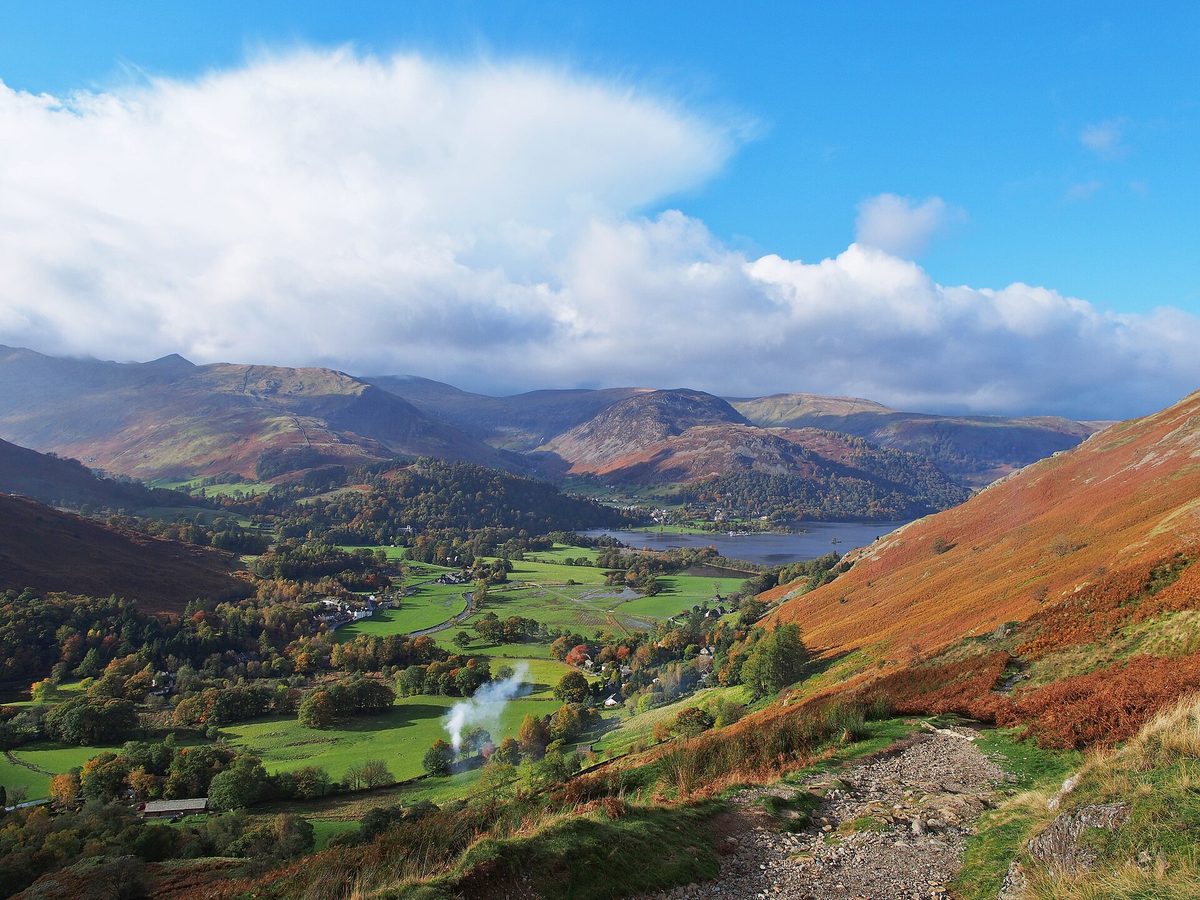
The Lake District is the place to go when you want England to feel big. The landscapes are not alpine in scale, but they have drama: dark water, steep fells, dry-stone walls, sheep, passes, boats, and weather that can make the same view feel silver, green, or almost black within an hour. It is one of England’s most loved national parks and a UNESCO World Heritage landscape, and it deserves more than a quick photo stop.
Base yourself in Keswick for easy access to Derwentwater, Borrowdale, and northern walks; Ambleside or Windermere for transport, lake cruises, and a classic first visit; Grasmere for poetry and village atmosphere; or Ullswater for a slightly quieter lake base. Beginner walkers can enjoy lakeside routes and lower fells. Stronger hikers can look at Catbells, Helvellyn routes, Scafell Pike, or longer ridge days, with weather and ability taken seriously.
You can visit without a car by using trains to Oxenholme or Penrith and buses onward, but a car gives more flexibility. Give the Lake District at least three nights if you can. For deeper planning, use the Lakeland overview and hiking in England.
8. Cornwall
Cornwall is one of the best places to visit in England if your trip needs cliffs, beaches, fishing harbors, coastal paths, gardens, and a little distance from the obvious London orbit. It is beautiful, but it asks for time. That is the tradeoff. You do not add Cornwall to a five-day England trip unless Cornwall is the trip. From London, the journey is long enough that I would plan at least four nights, preferably more.
The rewards are strong: St Ives, Mousehole, Porthcurno, the Minack Theatre, Kynance Cove, Fowey, Padstow, Tintagel, the Lizard, Land’s End, and long sections of the South West Coast Path. Cornwall works for beach lovers, walkers, artists, seafood people, families, and road-trippers. It is also one of the places where England feels most distinct from its own stereotypes. The light, granite, surf, and harbors give it a rhythm of its own.
Planning note: summer is busy, parking can be tight, and distances take longer than they look. Choose one or two bases rather than trying to sleep somewhere new every night. Pair Cornwall with Devon if you have time, and use the Cornwall and Devon travel guide before committing to a route.

9. Devon
Devon gives you two coastlines, two national parks, and a softer alternative or companion to Cornwall. North Devon has surf beaches, rugged cliffs, and access to Exmoor. South Devon has estuaries, coves, Dartmouth, Salcombe, Totnes, and a more sheltered boating-and-seaside feel. Inland, Dartmoor is one of the most atmospheric landscapes in England, with granite tors, ponies, open moor, and villages that feel made for a wet afternoon by the fire.
Devon is excellent for travelers who want a road trip with variety. You can build a route around Exeter, Dartmoor, the English Riviera, Dartmouth, Salcombe, and north coast beaches, or combine it with Cornwall on a longer southwest trip. Families often find Devon easier than Cornwall because there is so much variety within shorter drives, though peak summer still needs planning.
If you are choosing between Devon and Cornwall, think about mood. Cornwall is more dramatic and iconic. Devon is more flexible and varied. Both are strong choices for the seaside guide cluster, and together they can fill a two-week southwest holiday without feeling repetitive.
10. Dorset And The Jurassic Coast
Dorset is one of the most rewarding coastal regions in England because it combines scenery, fossils, beaches, villages, and manageable distances. The Jurassic Coast is the headline, with Durdle Door, Lulworth Cove, Chesil Beach, Lyme Regis, West Bay, and cliffs that tell a geological story as you walk. It is dramatic without being as far from London as Cornwall, which makes it especially useful for visitors who want a proper coast experience on a shorter trip.
Lyme Regis is a lovely base if you want fossils, independent shops, and a classic seaside feel. Swanage works well for families and for access to the Isle of Purbeck. Weymouth gives you a broad sandy beach and practical transport. Inland, Dorset has villages, hillforts, gardens, and quiet lanes that make it a good road-trip region.
Planning note: do not stand under unstable cliffs, and check tide and coast path conditions before long walks. Dorset is best in spring, early summer, or September if you want good light without peak crowds. It pairs naturally with Bath, Salisbury, Stonehenge, Devon, or the New Forest.
11. Brighton And The Seven Sisters
Brighton is England’s classic easy seaside escape from London, but the stronger trip is Brighton plus the South Downs and Seven Sisters cliffs. Brighton gives you the pier, the Lanes, cafes, nightlife, vintage shops, the Royal Pavilion, and a proud alternative streak. The Seven Sisters give you one of the most memorable coastal walks in southern England: white chalk cliffs, green downland, sea wind, and wide views over the Channel.
This is a good choice if you want coast without a long journey. Brighton is simple by train from London, and the cliffs can be reached by bus or organized day trip depending on your route. If you have only one day, choose either Brighton city time or a Seven Sisters walk; combining both can work, but it becomes a long day. If you have a weekend, it is much better.

Planning note: the cliffs are not a theme-park viewpoint. Wear sensible shoes, stay back from the edge, and prepare for wind. For more seaside planning, use England coast and beaches.
12. Stonehenge, Salisbury And Avebury
Stonehenge is famous enough that some travelers wonder if it can live up to its reputation. My answer is: it depends how you visit. If you expect a lonely stone circle in an empty field, modern visitor management may surprise you. If you understand it as part of a wider prehistoric landscape, it becomes much more interesting. Stonehenge is best paired with Salisbury, Old Sarum, or Avebury rather than treated as a stand-alone photo stop.
Salisbury is worth time in its own right. The cathedral is magnificent, the close is peaceful, and the city gives you a more rounded day than Stonehenge alone. Avebury is different again: a village inside a huge stone circle, more spread out, less controlled, and for some visitors more atmospheric. If you love ancient sites, include both Stonehenge and Avebury. If you are only mildly curious, Stonehenge plus Salisbury is enough.
Planning note: from London, you can go by train to Salisbury and take a bus or tour onward. Many tours combine Stonehenge with Bath or Windsor, but those days can feel rushed. If heritage is your main theme, use England castles and historic sites and the UNESCO World Heritage Sites in England guide.
13. Canterbury And The White Cliffs Of Dover
Canterbury is one of England’s great cathedral cities, and it works particularly well for visitors who want medieval streets without going all the way to York. The cathedral is the anchor, but the city also has riverside walks, timbered buildings, old lanes, and enough cafes and pubs to make a day feel easy. It is a strong choice from London, especially if you are interested in pilgrimage history, Chaucer, church architecture, or compact historic towns.
Dover is nearby, and the White Cliffs are iconic for a reason. Dover Castle adds a huge amount of history, from medieval defenses to wartime tunnels, and the cliff walks give you the coastal drama. Canterbury and Dover can be combined in a day if you start early, but it is better as an overnight in Kent if you want to avoid clock-watching.
Planning note: Canterbury is easier by train than many visitors expect. Dover requires more walking, taxis, buses, or careful timing depending on what you want to see. This pairing also fits well into a day trips from London strategy.
14. Windsor
Windsor is one of the easiest royal day trips from London. Windsor Castle is the reason most people go, and it is a strong one: state rooms, St George’s Chapel, royal history, and a town wrapped around the castle walls. The Thames is right there, Eton is across the bridge, and the whole visit can be done without complicated logistics.
Windsor is especially useful for travelers who want a high-impact day outside London without losing half the day in transit. It also works well for families, multi-generation trips, and first-timers who want royal history but do not want to rent a car or navigate rural bus routes. If your schedule is tight, Windsor competes with Oxford, Cambridge, Brighton, and Bath for day-trip space. It does not have the same depth as Bath or York, but it is one of the simplest wins.
Planning note: book castle tickets ahead in busy periods and check opening details because royal sites can close for official events. If you are already planning a castle-heavy trip, Windsor belongs in the broader castles in England cluster.
15. Stratford-Upon-Avon And Warwick
Stratford-upon-Avon is famous as Shakespeare’s birthplace, but the best version of a visit is not just house-to-house sightseeing. It is the river, the theatre, the market-town scale, the timbered buildings, and the chance to see a Royal Shakespeare Company production if timing works. It can be touristy, yes, but that does not mean it is empty. Go with the right expectations and it is a rewarding stop.
Warwick is nearby and gives you one of England’s most accessible castle experiences. Warwick Castle is more commercial and family-oriented than some historic sites, but it is memorable and easy to understand, especially with children. Together, Stratford and Warwick make a strong Midlands pairing. Add Kenilworth Castle, the Cotswolds, or Oxford, and you have a good two- or three-day route through central England.
Planning note: Stratford can be reached by train, but the area becomes easier with a car if you are combining several small towns and countryside stops. This is also a useful alternative if the Cotswolds are fully booked or you want a literary angle.
16. Liverpool
Liverpool is one of England’s best city breaks because it has personality in abundance. The Beatles are the global hook, but the city is bigger than one story. You have the waterfront, music history, football culture, museums, Georgian streets, nightlife, bold civic buildings, and a friendliness that visitors often notice quickly. It is a city with edges, humor, pride, and a strong sense of itself.
For first-time visitors, the Royal Albert Dock, Museum of Liverpool, Maritime Museum, Beatles sites, cathedrals, and a ferry across the Mersey make a good base. Football fans may want Anfield or Goodison-related experiences, depending on loyalties and fixture timing. Music fans can build a full trip around Beatles history and live venues.
Liverpool pairs well with Manchester, Chester, North Wales, or the Lake District. It is also a good reminder that England’s best places are not only the postcard-pretty ones. If London shows you the capital and Bath shows you elegance, Liverpool shows you maritime, musical, working-city England with real warmth.
17. Manchester
Manchester is not always high enough on first-time England lists, partly because it does not fit the old village-and-castle fantasy. But if you care about music, football, industrial history, food, nightlife, architecture, or contemporary city energy, it belongs. Manchester is a practical northern base with strong rail links, an international airport, and easy access to Liverpool, Chester, the Peak District, Leeds, York, and the Lake District.
Spend time in the Northern Quarter, Ancoats, Castlefield, the canals, the museums, and the football grounds if that is your thing. The city has a different rhythm from London: more compact, less polished, and proud of its own cultural weight. It is also useful if you want to see northern England without making every day a long transfer.
Planning note: Manchester is a good base, but I would not choose it as the only non-London stop for a first trip unless your interests are strongly city-based. Pair it with the Peak District, Liverpool, York, or the Lake District to make the route sing.
18. The Peak District
The Peak District is one of the best places in England for accessible countryside. It sits close to Manchester, Sheffield, Derby, and Nottingham, which means you can reach real walking country without committing to a remote road trip. The landscapes split broadly between the gentler White Peak, with limestone dales and villages, and the wilder Dark Peak, with moorland, gritstone edges, and bigger walking days.
Bakewell, Castleton, Edale, Hathersage, Buxton, and Ashbourne all make useful bases or stops. Chatsworth House is one of the grandest stately homes in England, and it pairs beautifully with a Peak District trip. Walkers can choose anything from easy riverside paths to Kinder Scout. Non-walkers still have villages, caves, viewpoints, pubs, and scenic drives.
Planning note: the Peak District is a strong alternative to the Lake District if you have less time, want easier access from big cities, or prefer a less famous but still deeply satisfying national park experience. It belongs in the England national parks and hiking route family.
19. The Yorkshire Dales
The Yorkshire Dales are England at their most stone-walled and wind-shaped: green valleys, barns, waterfalls, market towns, caves, moorland, and walking routes that can feel both open and intimate. This is a place for hikers, drivers, pub lunches, village stays, and travelers who want northern countryside with a strong identity.
Good bases include Skipton, Settle, Grassington, Hawes, Richmond, and Leyburn. Malham Cove is one of the best-known natural sights, while Aysgarth Falls, Swaledale, Wensleydale, Wharfedale, and the Settle-Carlisle railway all deserve attention. The Dales pair naturally with York, Harrogate, Leeds, the Lake District, or the North York Moors.
Planning note: a car helps a lot, though the Settle-Carlisle railway gives train travelers a scenic way in. If your dream England trip involves long walks, stone villages, and evenings by a fire, the Dales may suit you better than the Cotswolds. They are less polished and, to me, often more moving.
20. North York Moors And Whitby
The North York Moors give you heather moorland, old abbeys, steam trains, big skies, and a dramatic drop to the Yorkshire coast. Whitby is the coastal star: ruined abbey, harbor, fish and chips, Dracula associations, jet shops, and steep old streets. Robin Hood’s Bay, Staithes, Runswick Bay, and the coast path add more reasons to linger.
This region works well if you want coast and countryside without going southwest. It is also a strong second-trip destination for travelers who have already seen London, Bath, and the Cotswolds and want a different texture. The North Yorkshire Moors Railway can add a heritage rail experience, and the drive across the moors is atmospheric even in imperfect weather.
Planning note: Whitby is not as quick to reach as Brighton or Dover, but it rewards the effort. Pair it with York for one of the best city-and-country combinations in northern England.
21. Northumberland Coast And Hadrian’s Wall
Northumberland is one of England’s great underused travel regions. It has castles, huge beaches, dark skies, Roman history, islands, market towns, and a feeling of space that can be hard to find farther south. Bamburgh Castle rising above the beach is the image most visitors remember, but the region is bigger than one view. Alnwick Castle, Holy Island, Seahouses, the Farne Islands, Craster, Dunstanburgh, and Hadrian’s Wall can fill several days.
This is a strong choice for history lovers, photographers, walkers, families, and travelers who want England without the busiest southern circuits. Hadrian’s Wall gives you Roman history and wild upland walking. The coast gives you castles and sea air. The distances are manageable with a car, though planning by train and bus is possible with care.
Planning note: tides matter for Holy Island, and weather can change plans quickly on the coast. Build in flexibility. Northumberland pairs well with Newcastle, Durham, York, or the Lake District on a longer northern route.
22. Bristol
Bristol is a creative, independent, slightly rebellious city that works well for travelers who want something more contemporary than Bath but still close to classic southwest routes. It has street art, harborside walks, Brunel engineering, strong food and coffee, music, museums, and easy access to Clifton Suspension Bridge. It is also a practical base for Bath, Somerset, South Wales, the Cotswolds, and parts of the west country.
I would choose Bristol if you like cities with a lived-in edge. It is less conventionally pretty than Bath, but it has more urban energy. You can visit both easily because they are close by train. Bath gives you elegance; Bristol gives you color, murals, hills, harbors, and a sense that people actually live their cultural lives there rather than performing them for visitors.
Planning note: Bristol is a good weekend city and a useful rail stop, but it is not usually a first stop for the classic London-plus-heritage route. Add it when you want food, art, nightlife, or a better southwest base.
23. Norfolk Broads And North Norfolk Coast
Norfolk is one of the best places to visit in England if you want big skies, waterways, birdlife, beaches, and a gentler pace. The Broads are a network of rivers and lakes best experienced by boat, while the north Norfolk coast gives you salt marshes, dunes, wide beaches, nature reserves, villages, and old seaside towns. Holkham, Wells-next-the-Sea, Blakeney, Cley, Sheringham, Cromer, and Burnham Market all attract different kinds of travelers.
This is not the place to rush. Norfolk works for families, birdwatchers, walkers, slow travelers, and anyone who wants the coast without Cornwall’s long drive or Brighton’s city buzz. Norwich adds a historic city base, with a cathedral, lanes, market, and independent shops.
Planning note: a car is very useful, especially on the coast. Norfolk is flatter, quieter, and more understated than many of England’s headline landscapes. That is the point. It is a place to exhale, watch the tide, and stop measuring the day by attractions.
24. The New Forest
The New Forest is a brilliant choice for travelers who want countryside, wildlife, cycling, villages, and easy access from London or the south coast. Despite the name, it is an old royal hunting forest with heathland, woodland, open common, and free-roaming ponies. Lyndhurst, Brockenhurst, Beaulieu, Burley, and Lymington are common bases or stops, and the coast is close enough to mix forest and sea in one trip.
Families often do well here because the activities are varied: cycling, walking, wildlife spotting, Beaulieu’s motor museum, village stops, cream teas, and nearby beaches or ferries. Couples can make it a quiet inn-and-walks escape. It is also easier to fit into a southern England itinerary than the Lake District or Cornwall if time is limited.
Planning note: respect the animals and local rules; the ponies are not props. The New Forest pairs well with Winchester, Salisbury, Dorset, the Isle of Wight, or a broader England road trip.
25. Durham And Chester
I am pairing Durham and Chester here because both are historic cities that can be overlooked by first-time visitors, and both are excellent if they fit your route. Durham is compact and dramatic, with its cathedral and castle set high above the River Wear. It works beautifully between York and Newcastle, or as part of a northeast route. The cathedral is one of the great buildings in England, and the riverside setting makes the city feel almost cinematic.
Chester, near the Welsh border, is different: Roman walls, black-and-white timbered rows, a handsome cathedral, riverside walks, and easy links to Liverpool, Manchester, and North Wales. It is especially useful if you want a historic city that feels manageable and photogenic without being as heavily touristed as York or Bath.
Planning note: Durham is the better fit for a northeast history route; Chester is better for northwest England and Wales combinations. Both belong in a deeper guide to England’s historic towns, and both can make a trip feel more personal than a route built only from the famous names.
Best Places In England By Travel Style
If you are still staring at the list and wondering what to choose, start with your travel style.
For first-time visitors, choose London, Bath, Oxford or Cambridge, York, and one countryside or coast region. That gives you variety without turning the trip into a transfer marathon.
For history lovers, prioritize London, Bath, York, Durham, Canterbury, Stonehenge, Salisbury, Oxford, Cambridge, Hadrian’s Wall, and Warwick. England is dense with history, but these places make it easy to understand.
For countryside and villages, choose the Cotswolds, Yorkshire Dales, Peak District, Lake District, New Forest, or North Norfolk. If you want polished villages and inns, choose the Cotswolds. If you want bigger landscapes, choose the Lakes or Dales. If you want easier access from cities, choose the Peak District.
For coast, choose Cornwall, Devon, Dorset’s Jurassic Coast, Brighton and the Seven Sisters, North Norfolk, Yorkshire coast, or Northumberland. Cornwall is the classic long coastal trip. Dorset is more compact. Northumberland is the quieter castle-and-beach choice.
For car-free travel, choose London, Bath, Oxford, Cambridge, York, Brighton, Canterbury, Liverpool, Manchester, Durham, and parts of the Lake District or Peak District with careful base planning. Use the England transport guide before booking rural stays.
For families, London, York, Warwick, the New Forest, Devon, Dorset, the Lake District, and the Cotswolds can all work well. The right choice depends on age, season, and how much driving you want. The England with kids guide is the better next step for family-specific planning.
For romantic trips, Bath, the Cotswolds, Lake District, Cornwall, North Norfolk, and York are the strongest choices. For budget-conscious trips, focus on rail-friendly cities with free museums and walkable neighborhoods: London, Liverpool, Manchester, York, Bristol, and Oxford can all be managed well with planning. Use the England cost guide before locking in dates.
Best Places In England By Trip Length
With three to five days, stay realistic. Choose London plus one or two day trips, or skip London and do one compact region well. Good short combinations include London and Bath, London and York, London with Oxford and Windsor, or Bath with the Cotswolds.
With seven days, build a clean triangle. I would consider London, Bath, and the Cotswolds; London, York, and the Lake District; or London, Oxford, Bath, and Brighton. You can see more, but you will feel it in your legs and your luggage.
With ten days, England starts to open up. Try London, Bath, Cotswolds, and York; or London, York, Lake District, and Manchester; or London, Dorset, Devon, and Cornwall if the coast is the whole point. Ten days is enough for variety, but not enough for every region.
With two weeks, you can do a strong first-time England route: London, Bath, Cotswolds, York, Lake District, and either Oxford/Cambridge or Liverpool/Manchester. You could also build a southern route around London, Oxford, Bath, Cotswolds, Dorset, Devon, and Cornwall.
With three weeks or more, stop thinking only in highlights. Add Northumberland, Norfolk, the Yorkshire Dales, the North York Moors, Chester, Durham, Bristol, or the New Forest. This is where quieter corners of England and an England bucket list by region become more useful than another generic top ten.
The Best Regions To Visit In England
London and South East England are best for first-time access, royal sites, easy day trips, museums, Oxford, Brighton, Canterbury, Windsor, and the South Downs.
South West England is best for Bath, Bristol, the Cotswolds edge, Dorset, Devon, Cornwall, beaches, gardens, seafood, and road trips.
The Midlands are best for Stratford-upon-Avon, Warwick, Birmingham, the Peak District, Lincoln, and central countryside routes that many international visitors skip.
Yorkshire is best for York, the Yorkshire Dales, North York Moors, Whitby, market towns, moody landscapes, and some of England’s strongest historic character.
North West England is best for Liverpool, Manchester, Chester, the Lake District, music, football, industrial history, and mountain scenery.
North East England is best for Durham, Newcastle, Northumberland, Hadrian’s Wall, castles, beaches, and big-skied coastal drives.
East of England is best for Cambridge, Ely, Norwich, Norfolk Broads, north Norfolk coast, Suffolk villages, and slower trips with water, birds, and skies.
If you want a fuller geographic breakdown, use England’s regions explained. It is one of the most useful planning steps because “best” changes completely once you see how the regions connect.
Common England Planning Mistakes To Avoid
The first mistake is trying to do London, Bath, Cotswolds, York, Lake District, and Cornwall in one week. It is technically possible to touch several of those places. It is not a good holiday for most people.
The second mistake is treating Cornwall, the Lake District, and the Cotswolds as if they are quick day trips from London. The Cotswolds can be a day trip with a tour, but it is better overnight. The Lake District and Cornwall deserve several days.
The third mistake is renting a car too early. You do not need a car in London or for most major city-to-city routes. Rent one only when the rural part begins, and return it before entering a big city if you can.
The fourth mistake is assuming summer is always best. Summer has long days and festivals, but it also has higher prices and more crowds. Spring and September are often excellent. For a deeper seasonal decision, use when to visit England.
The fifth mistake is forgetting entry basics. Depending on nationality, many visitors now need an Electronic Travel Authorisation or a visa to travel to the UK. Check official requirements before booking non-refundable plans.
Final Thoughts
The best places to visit in England are not just the famous ones. They are the places that fit the trip you actually want to take. If this is your first visit, London, Bath, Oxford or Cambridge, York, the Cotswolds, and one coast or national park will give you a brilliant introduction. If you have been before, go deeper: Northumberland, Norfolk, the Yorkshire Dales, Durham, Chester, Dorset, Devon, the Peak District, or the North York Moors can change the way you think about the country.
My strongest advice is simple: choose fewer bases, give each place more time, and let England be more than a checklist. The country is at its best when you leave room for the walk after dinner, the village you did not plan on, the museum you only entered because it started raining, and the train ride that turns into part of the story.
Next, move from inspiration to structure with the England itinerary planner, then use England by train and transport, picking where to base yourself, and the regional guides for London, the Cotswolds, the Lake District, and Cornwall and Devon.
Research And Source Notes
This guide was planned against current SERP patterns and checked against official tourism and travel sources, including VisitEngland regional destination information, VisitBritain inbound tourism and visitor attraction research, National Parks UK, Historic England World Heritage information, GOV.UK visitor entry guidance, and image licensing for openly licensed photography. Images are sourced from Wikimedia Commons under their respective open licenses, with attribution in the Photo Credits section.
Photo Credits
- The Palace of Westminster in London, one of the best places to visit in England — Photo: Mike Peel / CC BY-SA 4.0 via Wikimedia Commons. Source
- A Cotswolds village street with honey-stone houses, one of the most beautiful places in England — Photo: Jonathan Billinger / CC BY-SA 2.0 via Wikimedia Commons. Source
- Buttermere in the Lake District, one of the best places to visit in England for scenery and walking — Photo: Anthony Foster / CC BY-SA 2.0 via Wikimedia Commons. Source
- A broad Cornwall beach and coast, one of the best places to go in England for seaside scenery — Photo: Simon Cobb (CC0) via Wikimedia Commons. Source
- The Seven Sisters cliffs in East Sussex, one of the most beautiful coastal places in England — Photo: kallerna / CC BY-SA 4.0 via Wikimedia Commons. Source
Frequently asked questions
What is the nicest place to visit in England?
There is no single nicest place to visit in England, but Bath, York, the Cotswolds, the Lake District, Cornwall, and London are the strongest all-around answers for most visitors. Bath is the easiest beautiful city break. York is the best compact historic city. The Cotswolds are the classic village-and-countryside choice. The Lake District is best for scenery and walking. Cornwall is best for coast. London is best for culture, museums, theatre, and first-time landmarks.
Where should I go in England for the first time?
For a first trip to England, I would start with London, then add two or three of Bath, Oxford, Cambridge, York, the Cotswolds, Stonehenge, Brighton, or the Lake District depending on your time. If you have one week, do not go too far in every direction. If you have two weeks, London, Bath, the Cotswolds, York, and the Lake District make a strong first-time route.
Is northern or southern England better to visit?
Southern England is easier for many first-time visitors because London, Bath, Oxford, Cambridge, Windsor, Brighton, Stonehenge, and the Cotswolds fit together well. Northern England is better if you want York, the Lake District, Yorkshire, Northumberland, Liverpool, Manchester, Durham, and bigger landscapes. The best choice depends on your interests. If you have two weeks, combine both.
How many days do you need in England?
You can enjoy England in five to seven days if you focus on London and one or two nearby places. Ten days gives you enough time for London, a historic city, and one countryside or coastal region. Two weeks is much better for a first-time England itinerary with both north and south. Three weeks lets you slow down and include less obvious regions.
Can you visit England without a car?
Yes, you can visit England without a car if you focus on London, Bath, Oxford, Cambridge, York, Brighton, Canterbury, Liverpool, Manchester, Durham, and rail-friendly bases. A car is helpful for the Cotswolds, Cornwall, Devon, Dorset, Northumberland, the Yorkshire Dales, the North York Moors, and parts of the Lake District. The best approach is often train between cities and car only for rural days.
What are the most beautiful places in England?
The most beautiful places in England include the Lake District, Cornwall, the Cotswolds, Seven Sisters cliffs, the Yorkshire Dales, Dorset’s Jurassic Coast, Northumberland coast, the Peak District, the New Forest, and the North York Moors. For cities, Bath, York, Oxford, Cambridge, Durham, and Chester are among the most beautiful.
What are the best places to visit near London?
The best places to visit near London include Windsor, Oxford, Cambridge, Bath, Brighton, Canterbury, the Seven Sisters, St Albans, Winchester, Rye, and parts of the Cotswolds on a guided tour. For easy train day trips, Oxford, Cambridge, Brighton, Windsor, and Canterbury are the most straightforward.
Is Cornwall worth visiting?
Cornwall is absolutely worth visiting if you can give it enough time. It is one of England’s best regions for coast, beaches, walking, fishing villages, gardens, and seafood. It is not ideal as a rushed add-on from London. Plan at least four nights if you can, and more if you want to explore beyond one base.
Is the Lake District worth visiting?
The Lake District is worth visiting if you like scenery, walking, lakes, villages, and outdoorsy travel. It is one of England’s most beautiful regions and one of its ten national parks. It is less rewarding if you only have time to pass through quickly. Give it at least two or three nights, and longer if hiking is a priority.
What should I skip on a short England trip?
On a short England trip, skip anything that forces too much travel time for too little reward. That usually means saving Cornwall, Northumberland, the Lake District, or multi-stop rural road trips for a longer visit unless they are your main reason for coming. A tight route done well is better than a famous route done badly.