Sheet 20 · England Coast and Beaches · 18 min read
Seven Sisters Cliffs Guide
A first-hand Seven Sisters cliffs guide: how to get there, the best clifftop walks, the postcard viewpoint, Birling Gap and safety tips.
 Sheet 20
Contents 9 sections
The first time I stood on Seaford Head and looked east, I actually laughed out loud. There they were: seven rolling waves of blinding white chalk, dropping straight into a slate-grey sea, with the little river Cuckmere snaking through the meadow below. I had seen the photo a hundred times. Standing in front of it, in a wind that nearly took my hat, was something else entirely.
This Seven Sisters cliffs guide is everything I wish someone had told me before my first trip: that the iconic photo is not taken from the cliffs at all, that the walk is more exposed than the postcards suggest, and that getting there is genuinely easy if you know which train and bus to take. I have walked this stretch in spring sun, autumn drizzle, and one memorable January gale, and I will tell you exactly how to do it well.
Quick Answer: Seven Sisters Cliffs Guide
The Seven Sisters are a run of seven white chalk cliffs on the East Sussex coast, between Seaford and Eastbourne, inside the South Downs National Park. The famous postcard view is from Seaford Head over Cuckmere Haven, not from the cliffs themselves. Reach them by train to Seaford or Eastbourne, then walk or take the coastal Coaster bus.
If you only have a day and you want the picture everyone knows, head to Seaford Head. If you want the big cliff-top experience, walk the South Downs Way from Eastbourne over the tops to Birling Gap and on toward Cuckmere. I will cover both, plus everything in between.
Before you go, it is worth understanding where this fits into the bigger picture. The Seven Sisters are one chapter of England’s coast and beaches guide, a coastline that runs from the granite of Cornwall to the basalt of the far north. This piece is the deep dive on this one, unforgettable stretch.
Where Are the Seven Sisters?
The Seven Sisters sit on the south coast of England, in East Sussex, roughly midway between the small town of Seaford to the west and Eastbourne to the east. They form part of the South Downs National Park, and the cliff tops are crossed by the South Downs Way, England’s chalk-country National Trail.
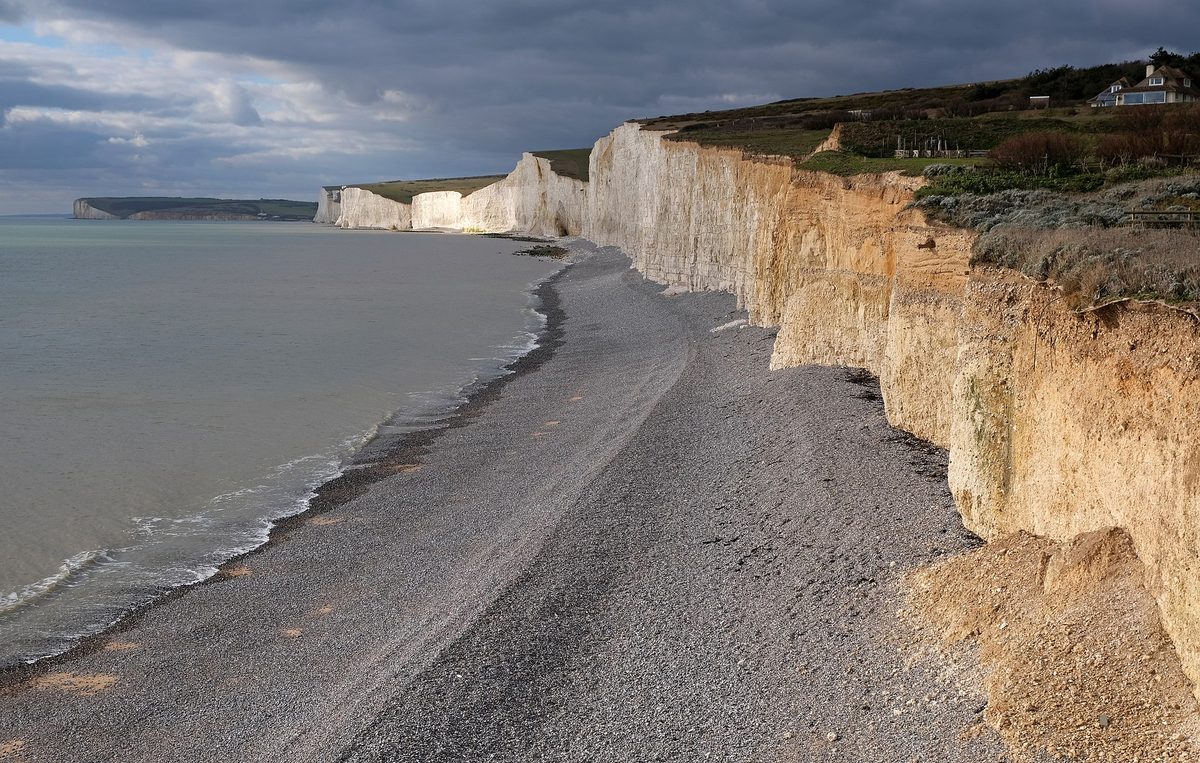
The cliffs are exactly what they sound like: a sequence of chalk hills that have been sliced clean through by the sea, leaving seven (technically now eight) dazzling white faces marching along the coast. From west to east the individual brows have wonderful old names: Haven Brow, Short Brow, Rough Brow, Brass Point, Flagstaff Brow, Bailey’s Hill and Went Hill. Erosion has carved a small additional dip over the years, so pedants will tell you there are eight, but the name has stuck for centuries and nobody is changing it now.
People constantly confuse the Seven Sisters with the white cliffs of Dover, which are a separate, equally famous set of chalk cliffs further east in Kent. They are not the same place. The Seven Sisters are the undulating, multi-peaked ones with no town behind them; Dover is a single great wall with a busy ferry port at its foot. If you want to understand how all these chalk coasts relate, the best beaches in England round-up sets them side by side.
At the western end, where the cliffs begin, sits Cuckmere Haven, a wide, undeveloped river valley where the Cuckmere reaches the sea in a series of lazy meanders. At the eastern end, just past the cliffs, is Birling Gap, a National Trust site with a café, and beyond that the higher ground of Beachy Head. The whole stretch is one continuous, glorious chalk coastline. Once you have seen it, you will understand why it ranks among the finest scenery in England’s national parks for hiking.
Why are they called the Seven Sisters?
The name simply comes from the seven distinct hilltops you see in silhouette along the coast. Each rise and dip reads as a separate “sister.” There is no romantic legend behind the individual brow names; as far as anyone can tell, they are just old local labels handed down over generations. The poetry is in the shape, not the story.
How to Get There
Here is the genuinely good news for a destination this beautiful: you do not need a car. The Seven Sisters are one of the most accessible bits of dramatic coast in England, sitting an easy train ride from London and a short hop from Brighton. Below is the at-a-glance version, then I will break each option down.
| Coming from | Best route | Rough journey time | Notes |
|---|---|---|---|
| London | Train Victoria → Seaford (change at Lewes) | ~1 hr 25 min | Or direct to Eastbourne (~1 hr 30 min) |
| Brighton | Coaster bus 12/12A/12X along the A259 | ~1 hr to Exceat | Scenic; runs frequently all day |
| Eastbourne | Bus 13X (seasonal) or 12/12A, or walk | 15-30 min by bus | 13X serves Birling Gap and Beachy Head |
| By car | A259 to Exceat (BN25 4AD) or Birling Gap (BN20 0AB) | Varies | Pay-and-display; arrive early in summer |
Brighton makes the most relaxed base if you want to stay a night or two; my Brighton travel guide covers where to sleep and eat before you head along the coast.
By train
This is how I usually go. From London, take a Southern service from London Victoria toward Seaford, changing at Lewes (often a same-platform connection). Total time is around 1 hour 25 minutes. From Seaford station it is about a one-hour walk along the seafront and over Seaford Head to reach the Country Park at Exceat, or a short bus ride if you would rather skip the road section.
Alternatively, take a direct train to Eastbourne (roughly 1 hour 30 minutes from Victoria), which puts you at the eastern end near Beachy Head and Birling Gap. The smartest day-trippers buy a single to one end and a single back from the other, so they can walk the whole thing one way without backtracking.
For the full lowdown on tickets, off-peak timing and which lines serve the Sussex coast, see my England train travel guide, and for a wider list of escapes, the best day trips from London by train puts the Seven Sisters in good company.
By bus
The workhorse of this coast is the Brighton & Hove Coaster, routes 12, 12A and 12X, which run along the A259 between Brighton, Seaford and Eastbourne. Crucially, all of them stop right at the Seven Sisters Country Park Visitor Centre at Exceat, and they connect with the railway stations at Seaford, Brighton and Eastbourne. The 12X is the limited-stop express; the 12 and 12A make more stops. It is a properly scenic ride, so grab the top deck if you can.
For the eastern cliffs, look for the seasonal 13X, which follows much the same route as the 12X but extends to serve Birling Gap and Beachy Head. As of 2026 the 13X runs most frequently on Sundays between April and October, roughly every 30 minutes, so check the current timetable before you rely on it.
By car
If you drive, the two main places to leave the car are the Seven Sisters Country Park car parks at Exceat (satnav BN25 4AD) and the National Trust car park at Birling Gap (satnav BN20 0AB). At Exceat there are two pay-and-display car parks; as of 2026 expect to pay around £3 for up to two hours or about £4 for the day, with machines taking cards and coins but not notes (you can also pay online via the RingGo app). The car parks open at 07:00 year-round and close in the evening, earlier in winter.
A word of warning from experience: on a sunny weekend these car parks fill up fast and there is very little alternative parking nearby. Arrive before 10am or be prepared to wait. If you are stitching the cliffs into a wider loop of the south coast, my south England road trip maps out a sensible driving route.
The famous-photo tip
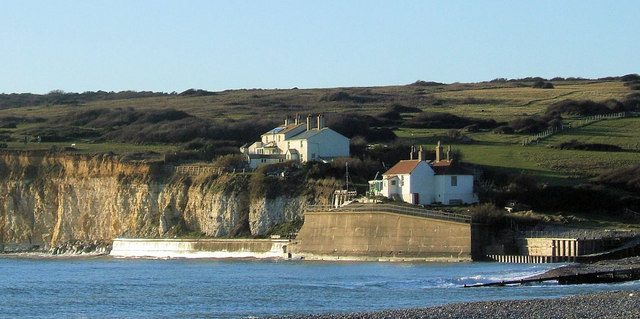
Here is the single most useful thing in this whole guide, and the thing the brochures bury: the iconic photograph of the Seven Sisters is not taken from the cliffs at all. It is taken from Seaford Head, on the far west side of the Cuckmere valley, looking back east across the meanders toward the coastguard cottages, with all seven cliffs stacked behind them.
So if you arrive at the Country Park, walk the cliff tops all day, and wonder why you never found “the view,” that is why. You were standing on it, not in front of it. To get the postcard, you need to be on the opposite headland. I cover exactly how below.
The Best Walks
You do not have to choose between a gentle stroll and an all-day hike here; this coast offers both. Below are the three walks I recommend most often, depending on how much time and energy you have brought.
| Route | Start / End | Distance | Time | Difficulty | Best for |
|---|---|---|---|---|---|
| Seaford Head viewpoint | Seaford / Seaford Head | ~2-3 miles return | 1-1.5 hrs | Easy-moderate | The postcard photo |
| Clifftop: Eastbourne → Birling Gap | Eastbourne / Birling Gap | ~5-6 miles | 2.5-3 hrs | Moderate | Big cliff-top drama |
| Full traverse: Seaford → Eastbourne | Seaford / Eastbourne | ~13 miles | 5-7 hrs | Hard | A proper day’s hike |
Whichever you pick, wear proper shoes and bring a windproof layer. This is one of the most rewarding day hikes in England’s national parks, but it is genuinely exposed.
Seaford Head and the Cuckmere Haven viewpoint
If you want the famous shot and you do not want a marathon, this is the walk. Start in Seaford, head up onto Seaford Head, and follow the coast path eastward toward the cliff edge above the river mouth. The classic spot is on the path just above the old coastguard cottages, where the buildings sit in the foreground and the seven chalk faces line up behind them across the valley. A short detour down toward Hope Gap gives you a different angle and some lovely rock pools at low tide.
It is a modest walk, perhaps two to three miles there and back depending on how far you wander, and the payoff is enormous. This Cuckmere Haven viewpoint is the one that has appeared on stamps, in films and on the cover of half the guidebooks to southern England. Early morning is magic here, when the rising sun lifts over the Sisters and rakes across the chalk, throwing the cliff folds into relief.
The clifftop walk: Eastbourne to Birling Gap
This is the one for the full cliff-top experience. Starting from Eastbourne, climb out of town past Beachy Head, with its giddy drop and lighthouse far below, then follow the South Downs Way westward along the tops past Belle Tout to Birling Gap. From Birling Gap the path continues up and over the Seven Sisters themselves, each climb a little leg-burner, each summit a fresh sea view.
The full stretch from Eastbourne to Birling Gap is around five to six miles and takes a comfortable couple of hours plus stops. The relentless up-and-down over the actual Sisters, from Birling Gap toward Cuckmere, adds another chunk; the National Trust’s own Birling Gap to Exceat clifftop route is the spine of it. There is no shade and no shelter, so it can be brutal in a headwind, but on a clear day, with the chalk blazing white and the Channel stretching to France, there is nowhere finer.
Cuckmere Haven and the Country Park
Not everyone wants the cliff slog, and the Seven Sisters Country Park at Exceat is the gentler alternative. From the Visitor Centre you can stroll the flat, easy path alongside the Cuckmere river as it meanders to the sea, a roughly flat walk of a couple of miles round trip that even small children can manage. The beach at the river mouth is wild and shingly, and you get a fine low-angle look at the western Sisters rising to your left.
This is also the place to slow down: there are tearooms near the Visitor Centre, kayak and bike hire from on-site partners, and water meadows full of birdlife. If your trip is more about scenery and a picnic than summit-bagging, start here. It pairs beautifully with the kind of unhurried day I describe in my best seaside towns in England guide.
Birling Gap and Beachy Head
The eastern end of the cliffs has its own distinct character, and it is well worth building into your day. Birling Gap is owned by the National Trust and is the only easy access point down to the beach along this whole stretch, via a set of metal steps bolted to the cliff. There is a café, a small shop, toilets and a car park, making it the natural pit stop or turnaround point on a cliff walk.
Birling Gap is also where the relentless reality of coastal erosion is most visible. The old coastguard cottages here have been steadily lost to the sea; one was demolished in 2014 when the cliff edge crept within a few metres (others went in 1994 and 2002), and storms have claimed more since. It is a sobering, fascinating place to understand just how fast this coast is changing.
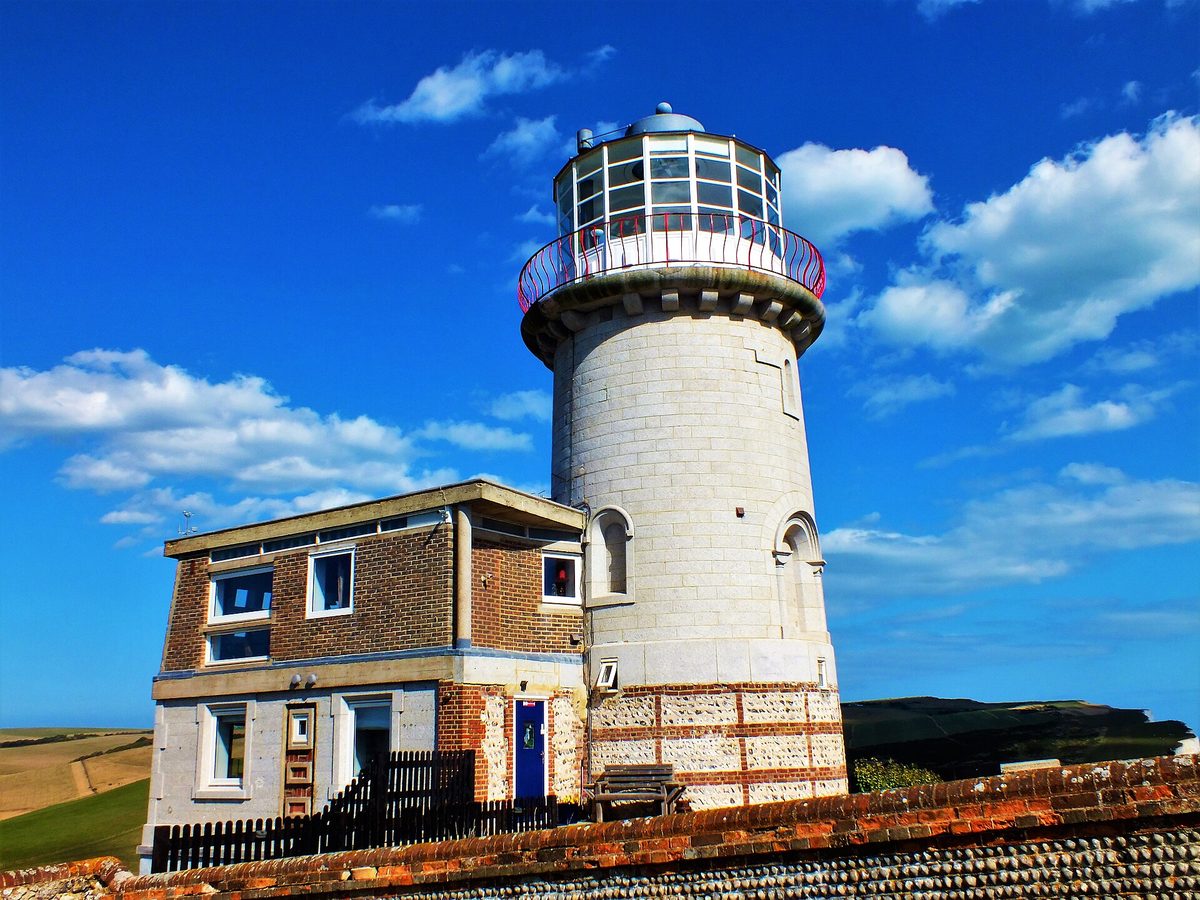
Just west of Birling Gap, on the high ground, stands Belle Tout lighthouse. Built in the late 1820s (the granite tower was operational from 1834) and decommissioned in 1902, it was famously moved bodily inland in March 1999 to save it from the retreating cliff edge. Today it is a private bed and breakfast, not open to casual visitors, but it is a striking landmark on the skyline and a great photo subject.
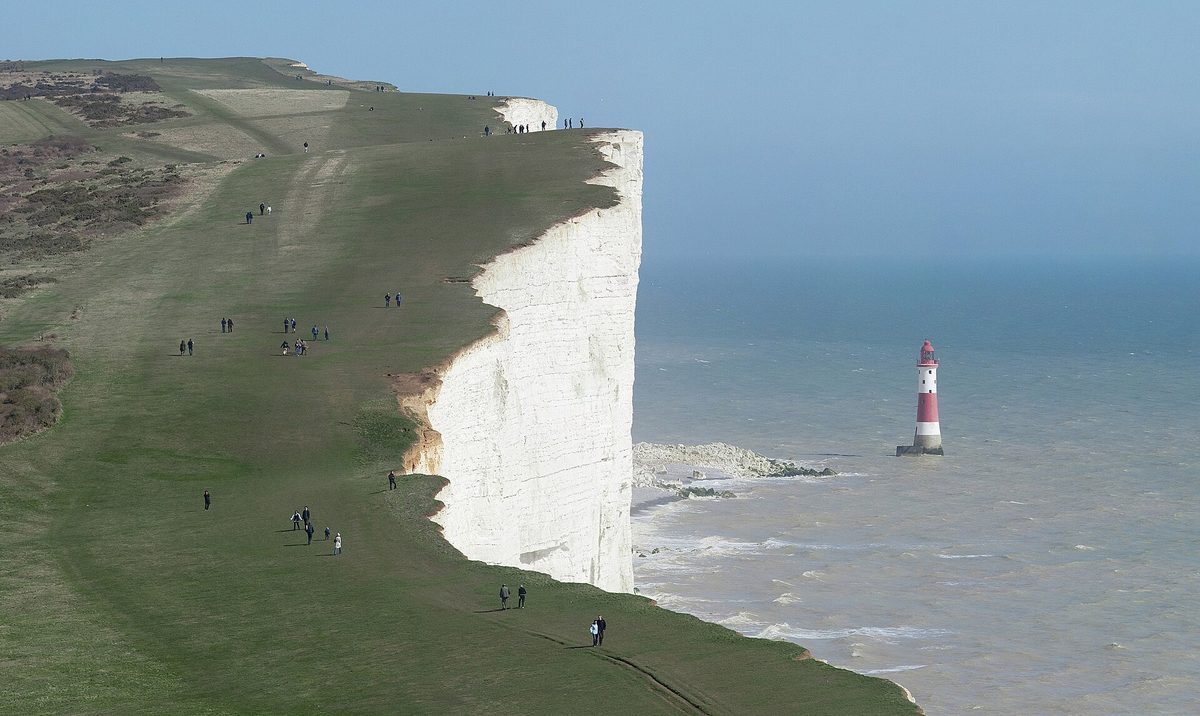
Continue east and you reach Beachy Head, the highest chalk sea cliff in Britain at around 162 metres, with the red-and-white Beachy Head lighthouse standing in the surf far below. The lighthouse became operational in 1902 and is one of the most photographed in the country. The view back along the Sisters from up here is tremendous.
Safety, Tides and Timing
I want to be honest with you, because this is the part casual blog posts skim over. The Seven Sisters are stunning and they are also genuinely dangerous if you are careless. The chalk is soft, and cliff falls and landslides happen at any time and without warning, according to the National Trust, who manage Birling Gap. People are killed or injured here, and the coastguard is called out repeatedly every year.
The rules are simple and you should follow them without exception:
- Stay at least 5 metres back from the cliff edge, always. The grass can overhang thin air, and the edge can give way under your weight. Do not sit with your legs dangling, and please do not do it for a photo.
- Stay well back from the base of the cliffs too. Chalk falls from above, sometimes several metres of it at once.
- Check the tide times before you go down to any beach. The sea reaches the foot of the cliffs twice a day, and people get cut off and need rescuing here. At Birling Gap especially, always keep the beach steps in sight so you can get back up.
There is no lifeguard at Birling Gap, so the sea is entirely your own responsibility; consider the wind, the currents and unseen obstructions before swimming. If you walk the sandy patches at low tide, wear shoes: small weever fish bury themselves in the sand with venomous spines that deliver a nasty sting.
In an emergency, dial 999 and ask for the Coastguard, and state clearly that you are at the Seven Sisters or Birling Gap. There is a phone box in the Birling Gap car park next to the Coastguard Station. None of this should put you off; it should simply make you the sensible visitor who comes home with great photos and all their limbs.
Best Time to Visit and for Photos
The Seven Sisters are open 24 hours a day, 365 days a year; this is open-access land with no gates and no tickets. That means the question is not whether you can visit but when you should.
My favourite months are May and June: the cliff-top turf is at its greenest, wildflowers are out, the days are long, and you usually beat the deep-summer crowds. Spring and early summer give you that classic emerald-and-white contrast that makes the cliffs sing. For a broader sense of seasons across the country, my best time to visit England guide goes month by month.
Summer (July and August) is busiest and the car parks fill early, but the long evenings are wonderful for a late walk. Autumn brings the most dramatic light and emptier paths, though you should pack for changeable weather. Winter is starkly beautiful and almost deserted, but the wind off the Channel is no joke and the days are very short, so start early.
For photography, the magic hours are early morning and late afternoon, when low sun rakes across the chalk and picks out every fold of the cliffs. The classic Cuckmere Haven viewpoint from Seaford Head faces broadly east, so sunrise is the classic shot, when the low sun comes up over the Sisters. Whenever you come, pack layers and a proper windproof; whatever the forecast says inland, it is windier on the edge. My England packing list covers exactly what to bring for a day on the British coast.
How long should you spend at the Seven Sisters?
Honestly, you can tailor this to anything from a couple of hours to a full day. If you just want the Cuckmere Haven viewpoint from Seaford Head, allow two to three hours including travel from the station. For the proper cliff-top walk between Eastbourne and Birling Gap with photo stops and a café break, set aside a half day. And if you want to walk the entire coast from Seaford to Eastbourne, the whole thing is a satisfying full day out of five to seven hours of walking, so leave London early.
If you are short on time and want this as a single big day from the capital, it slots neatly into a roster of day trips from London, and a wider plan of your whole trip lives in my England travel guide.
Final Thoughts
The Seven Sisters are, for my money, the most purely cinematic stretch of the English coast you can reach on a day return from London. There is something deeply satisfying about that white chalk against a moody sky, the river meandering far below, the wind hammering at you on the tops.
Do it properly. Go for the Seaford Head view if you want the photograph, walk the cliff tops from Eastbourne if you want to feel it in your legs, and respect the edge so you come home to tell the tale. Then come back in a different season, because it is never quite the same place twice. If the white-chalk drama gets under your skin, the limestone of the Jurassic Coast itinerary and the wild beaches of the Northumberland coast guide are waiting, and London itself is endlessly close in my London travel guide.
Research and Source Notes
This guide draws on first-hand walking experience plus current official sources, checked in June 2026. Prices, parking fees and bus timetables change, so treat all figures as approximate and confirm before you travel.
- Seven Sisters Country Park (South Downs National Park Authority) — official “Getting here” and parking pages at sevensisters.org.uk, for the A259/Exceat location (BN25 4AD), the 12/12A/12X Coaster bus, walking times from Seaford and Birling Gap, and pay-and-display details.
- National Trust (Birling Gap and the Seven Sisters) — nationaltrust.org.uk, for cliff and tide safety guidance (stay 5m from the edge, keep beach steps in sight, no lifeguard, weever fish) and Birling Gap facilities and erosion history.
- Brighton & Hove Buses — for current Coaster route 12/12A/12X and seasonal 13X service to Birling Gap and Beachy Head.
- Belle Tout and Beachy Head lighthouses — for dates (Belle Tout granite tower operational 1834, moved inland 1999; Beachy Head lighthouse operational 1902) and current status of Belle Tout as a private B&B.
- RNLI / HM Coastguard — general coastal safety advice, including dialling 999 and asking for the Coastguard in an emergency.
Always check live tide times and the latest bus and rail timetables before setting out, and never approach the cliff edge for a photograph.
Photo Credits
- The Seven Sisters cliffs guide hero view: seven white chalk peaks dropping into the English Channel in East Sussex — Photo: kallerna / CC BY-SA 4.0 via Wikimedia Commons. Source
- The meandering Cuckmere river reaching the sea at Cuckmere Haven, the western end of the Seven Sisters — Photo: Simon Burchell / CC BY-SA 4.0 via Wikimedia Commons. Source
- The coastguard cottages at Cuckmere Haven with the Seven Sisters lined up behind, the classic viewpoint from Seaford Head — Photo: Kevin Gordon / CC BY-SA 2.0 via Wikimedia Commons. Source
- The red and white Beachy Head lighthouse standing in the sea below the towering chalk cliffs at the eastern end of the Seven Sisters — Photo: Diliff, Papa Lima Whiskey (edit) / CC BY-SA 3.0 via Wikimedia Commons. Source
- Belle Tout lighthouse standing on the clifftop above the Seven Sisters near Birling Gap, East Sussex — Photo: Tom Rayner / CC BY-SA 4.0 via Wikimedia Commons. Source
Frequently asked questions
Can you visit the Seven Sisters from London?
Yes, very easily, and it makes a brilliant day trip. Take a train from London Victoria to Seaford (about 1 hour 25 minutes, changing at Lewes) or direct to Eastbourne (about 1 hour 30 minutes). From either station you can walk to the cliffs or hop on the coastal Coaster bus. Buy singles to one end and back from the other to walk it one way.
Where is the best view of the Seven Sisters?
The best and most famous view is from Seaford Head, on the western side of the Cuckmere valley, looking east toward the old coastguard cottages with all seven cliffs lined up behind them. This is the postcard shot, and it is not taken from the cliffs themselves. Park near Seaford and walk up onto the headland to find it.
How long is the Seven Sisters walk?
It depends on the route. The full coast walk from Seaford to Eastbourne is around 13 miles and takes five to seven hours. The popular cliff-top section from Eastbourne to Birling Gap is roughly five to six miles. If you only want the famous viewpoint from Seaford Head, that is a much shorter two-to-three-mile round trip.
Is Birling Gap free to visit?
Birling Gap itself is open-access and free to walk; the National Trust does not charge admission to the beach or cliffs. You will pay for the car park if you drive (a pay-and-display fee that National Trust members can often have covered), and the café and shop charge as normal. The steps down to the beach are free to use, tide permitting.
Are the Seven Sisters and the white cliffs of Dover the same?
No. They are two different sets of white chalk cliffs. The Seven Sisters are in East Sussex, between Seaford and Eastbourne, and are famous for their seven undulating peaks. The white cliffs of Dover are further east in Kent, beside the cross-Channel ferry port, and form a single long cliff face rather than a series of separate hills.
Are the Seven Sisters cliffs dangerous?
They can be, so treat them with respect. The chalk is soft and cliff falls happen without warning, so stay at least 5 metres back from the edge and well clear of the base. Check tide times before going on any beach, keep the steps in sight at Birling Gap, and never sit on the edge. Sensible visitors have a wonderful, safe day.