Sheet 26 · England Coast and Beaches · 20 min read
Northumberland Coast Guide
A first-hand Northumberland coast guide: clifftop castles, empty beaches, Holy Island tides, Farne Islands puffins and how to get around.
 Sheet 26
Contents 10 sections
The first time I drove up here I came over a rise on the back road into Bamburgh and the castle just appeared, sitting on its black crag above an empty beach, and I actually pulled over because it didn’t look real. Then I spent the next morning sitting in a layby outside Holy Island watching the tide refuse to go out on my schedule. That’s Northumberland in two scenes: scenery that floors you, and a coast that makes you work to its own clock rather than yours.
This Northumberland coast guide covers the far north-east of England — the stretch of coast designated a National Landscape (an Area of Outstanding Natural Beauty) from Amble and Warkworth in the south up to Berwick-upon-Tweed at the Scottish border. Below you’ll find the castles, the tidal island of Lindisfarne, the puffin colonies of the Farne Islands, the huge empty beaches, the fishing villages, and exactly how to get around. It’s one leg of England’s broader coast and beaches guide.
This is a region not many overseas visitors reach, and that’s the whole point. England’s most famous coastlines get the crowds; this one gets the space. For the wider national picture you’ve got the parent England’s coast and beaches guide, and the beaches here also feature in the best beaches in England roundup. This article is the regional planning brief: what’s worth your time up here, and how to fit it together.
Quick Answer: Northumberland Coast Guide
The Northumberland coast is England’s emptiest great coastline — a 40-odd-mile run of castles, gold-sand beaches and fishing villages between Amble and Berwick-upon-Tweed. The unmissable trio is Bamburgh Castle, the Farne Islands for puffins and seals, and tidal Holy Island (Lindisfarne) — but check the causeway crossing times before you go. Give it three days. A car helps enormously.
Here’s the shape of the coast, south to north. I’ll explain every line further down.
| Place | Type | Don’t miss | Getting there |
|---|---|---|---|
| Warkworth | Castle + village | Percy castle on a loop of river, riverside hermitage | X18 bus; ~5 min from Alnmouth station by road |
| Alnmouth | Village + beach | Pastel houses, wide estuary beach | On the East Coast Main Line (Alnmouth station) |
| Alnwick | Castle + garden | Harry Potter castle, the Alnwick Garden next door | X18/bus from Alnmouth; ~10 min drive inland |
| Craster | Fishing village | Smoked kippers, walk to Dunstanburgh | X18 bus; small harbour car park |
| Dunstanburgh | Castle (ruin) | Most dramatic ruin on the coast, ~1.3-mile walk in | On foot from Craster only — no road to it |
| Embleton Bay | Beach | Empty sweep under the castle, Ship Inn at Newton | Walk from Craster/Newton; limited parking |
| Seahouses | Fishing village | Boat trips to the Farnes, fish and chips | X18 bus; harbour boat-trip booking offices |
| Farne Islands | Islands | Puffins (Apr–Jul), grey seals, terns | Boat only, from Seahouses harbour |
| Bamburgh | Castle + beach | The castle; the beach below it | X18 bus; village car parks |
| Holy Island / Lindisfarne | Tidal island | Priory ruins, Lindisfarne Castle — tide-locked | Causeway road at low tide ONLY |
| Berwick-upon-Tweed | Town | Elizabethan ramparts, the only walled town | East Coast Main Line (Berwick station) |
Short on time? If you’ve only got a day, do Bamburgh and a Farne Islands boat trip from Seahouses, and save Holy Island for a trip when the tide cooperates.
How Long Do You Need?
People ask me this constantly, and the honest answer is: more than a day, and you’ll wish you had a week.
One day is a smash-and-grab. You’ll get Bamburgh and maybe one other thing — a boat trip, or Dunstanburgh — and spend the rest driving. Fine if you’re passing through on a North of England road trip, but you’ll leave knowing you skimmed it.
Two days lets you split the coast: castles and a beach on day one, the islands (Farnes by boat, Holy Island by causeway) on day two. This is the brisk-but-satisfying version.
Three days is what I recommend to almost everyone. The extra day absorbs the thing that catches everyone out — the tide. Holy Island is only reachable for part of each day, and you can’t bend that to fit a packed schedule. Three days means you plan the island around the safe crossing window instead of panicking about it, and you still get the castles, a boat trip and a long walk.
Four or five days, and you can walk sections of the Northumberland Coast Path (a 62-mile waymarked route, part of the England Coast Path), do nothing on a beach for an afternoon, and drift up into Berwick. This coast rewards slowing down more than almost anywhere I’ve been in England — see the most beautiful places in England for why it keeps coming up.
A note on direction. I run it south to north, Amble up to Berwick, which puts Holy Island near the end of the trip. There’s a reason: by then you’ve got the rhythm of the place and you’ll have checked the tide a dozen times without thinking. If you come down from Edinburgh, just flip it.
The Castles
Northumberland has more castles than any other English county — the legacy of being the buffer zone in centuries of border wars with Scotland. On this coast alone you’ve got four worth real time, and they’re all different. For the national context on how castles work to visit (memberships, what’s a ruin versus a lived-in house) see the best castles in England and the broader England castles and historic sites guides — I’ll keep this to what’s specific up here.
Bamburgh Castle — the showstopper
If you see one castle, see this one. Bamburgh sits on a great basalt outcrop right above the beach, and the approach — whichever way you come — is genuinely cinematic. It’s been a royal Anglo-Saxon stronghold (the Bebbanburg of Bernard Cornwell’s novels and the Last Kingdom series), a medieval fortress, and since the late 19th century the private family home of the Armstrong family, who still own and live in it. That matters for one practical reason: it’s not English Heritage or National Trust, so those memberships don’t get you in. You pay the gate.
Adult admission was around £17 as of 2026; check bamburghcastle.com for current prices and opening days, which vary by season. Inside, the King’s Hall and the armoury are the highlights, and the views from the walls over the Farne Islands are worth the ticket alone. Give it a couple of hours, then walk down onto the beach — more on that below.
Dunstanburgh Castle — the romantic ruin
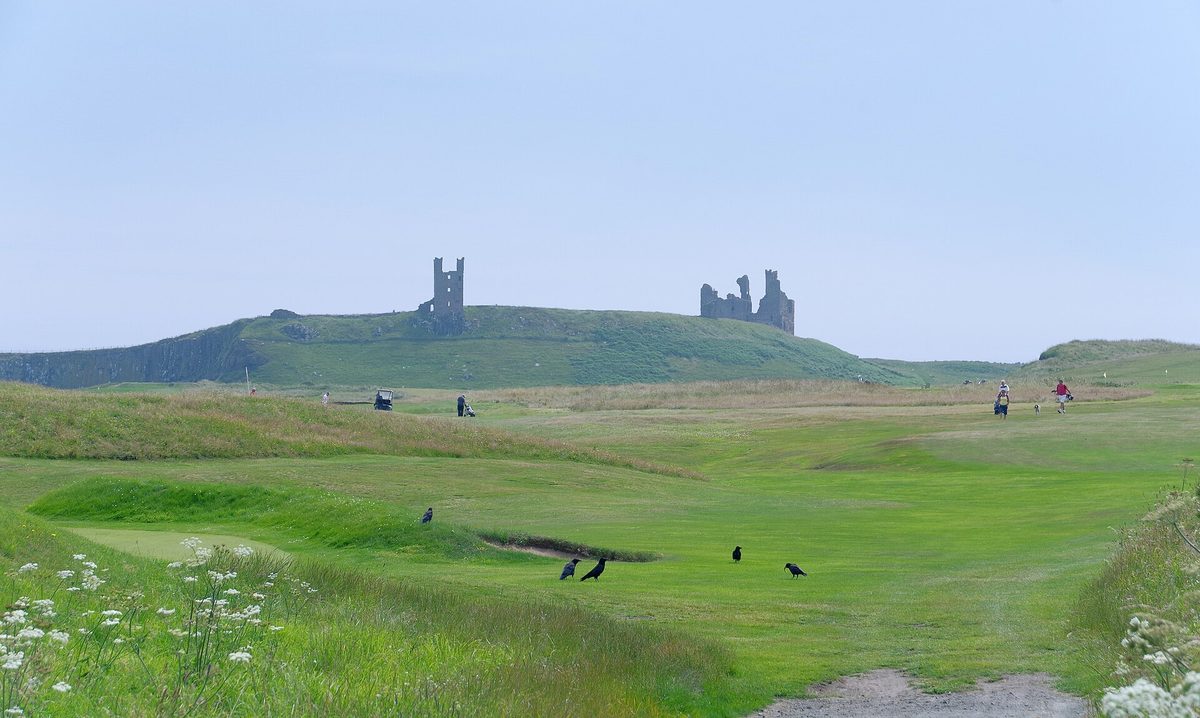
This is my sentimental favourite. Where Bamburgh is intact and grand, Dunstanburgh is a gaunt 14th-century ruin standing alone on a headland, and you can only reach it on foot — there’s no road. You park at Craster and walk roughly 1.3 miles along the coast path, sheep and sea on either side, with the broken towers growing on the horizon the whole way.
It’s owned by the National Trust and managed by English Heritage, so members of either can get in (worth knowing if you’ve got a card). The walk is half the experience; do it in decent weather and bring a coat regardless — that headland catches every gust off the North Sea. Honestly, if I had to choose, I’d take the atmosphere of Dunstanburgh over the grandeur of Bamburgh. But you don’t have to choose, so don’t.
Alnwick Castle — the Harry Potter one
Alnwick (say it “Annick”) is the big inland draw, about ten minutes from the coast. It’s the seat of the Duke of Northumberland — the Percy family — and it’s still very much lived in, which gives the state rooms a different feel from a ruin or a museum. It’s also where the early Harry Potter films shot Hogwarts exteriors, including the broomstick-flying lessons, and the castle leans into it with free guided film tours and broomstick training in season.
Two things to plan for. First, it’s seasonal — typically open late March to October, not year-round, so a winter trip means it’s likely shut. Second, Alnwick Castle and the Alnwick Garden next door are separate attractions with separate tickets (combination tickets exist). Castle admission ran around £18–19 as of 2026 depending on whether you book online; check alnwickcastle.com. The Garden, with its famous Poison Garden and giant water cascade, is a genuinely good half-day in its own right, especially with kids.
Warkworth Castle — the underrated one
At the southern end, Warkworth is the one most people skip, and they shouldn’t. The castle sits on a hill inside a near-complete loop of the River Coquet, with the pretty village tucked beneath it. It was a favoured residence of the Percys for centuries and turns up in Shakespeare’s Henry IV. It’s English Heritage. The quirk here is the Hermitage — a tiny chapel carved straight into the cliff rock upstream, reachable by a little ferry across the river in season. It’s one of the oddest, most peaceful spots on the whole coast.
Holy Island and Lindisfarne
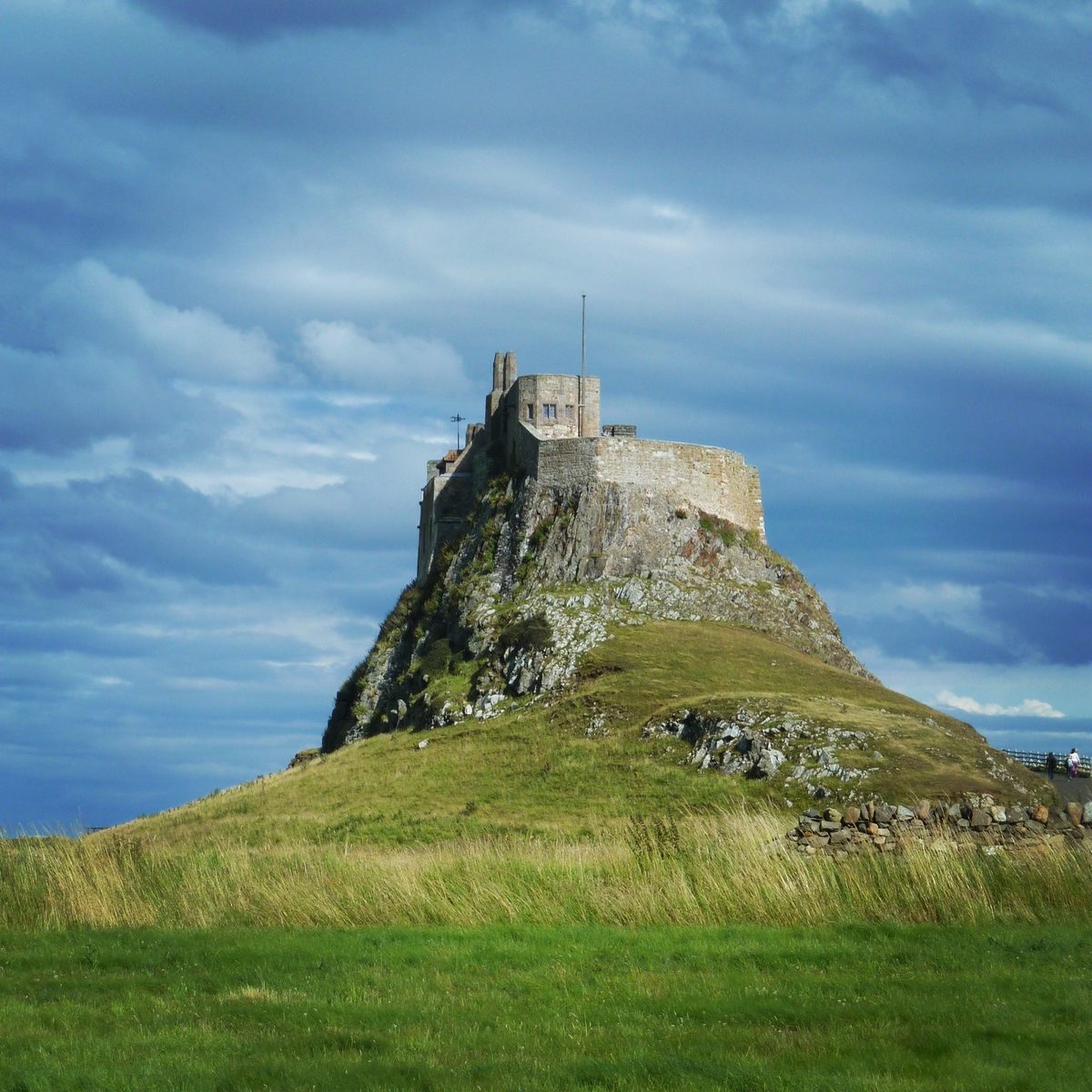
Holy Island — Lindisfarne — is the most atmospheric place on this coast, and the most logistically fiddly. It’s a genuine tidal island: the causeway road that connects it to the mainland floods completely twice a day, every day, and people get caught out and have to abandon cars on the raised refuge box almost every week in summer. You cannot wing this.
The causeway — read this before you go
Northumberland County Council publishes official safe crossing times for the causeway road, month by month, years in advance, at holyislandcrossingtimes.northumberland.gov.uk. Check them, and build your whole day around them. The safe window is not symmetrical and it’s not the same each day — it shifts with the tides.
To give you a real sense of how much of the day the road is closed: on Saturday 13 June 2026, the council’s table lists the road as safe to cross from 04:35 until 11:40, then unsafe from 11:40 until 17:05 — over five hours locked out in the middle of the day — before reopening in the evening. Those are typical numbers. So the classic mistake is to drive over mid-morning, potter happily round the island, and then find you can’t leave until late afternoon. Sometimes that’s fine. Sometimes it ruins your plans.
A few hard rules I follow. Always allow the extra 30 minutes the council recommends — wind can change the real water level. Never, ever drive onto a covered or covering causeway, no matter how shallow it looks; the sea comes in fast and salt water wrecks the car (and your insurer will not be sympathetic). And the marked walkers’ route across the sands — the Pilgrims’ Way — runs on a different schedule from the road and should only be attempted in daylight, with local knowledge, never on a rising tide.
What’s actually on the island
Once you’re across, the village is small and walkable. The two big sights are run by different organisations, which trips people up. Lindisfarne Priory — the ruins of the great medieval monastery, founded in the 7th century and home of the saints Aidan and Cuthbert and birthplace of the Lindisfarne Gospels — is English Heritage. Lindisfarne Castle, the little fairytale fort on a crag at the far end, remodelled by Edwin Lutyens into an Edwardian holiday home with a walled garden designed by Gertrude Jekyll, is National Trust. One card won’t cover both.
Is it worth the tide faff? Yes — but only if you give it time and treat the constraint as part of the experience rather than a nuisance. Allow two to three hours on the island minimum. Go early or late to dodge the day-trip crush, walk out to the castle, sit by the priory, and let the strange, cut-off quiet of the place do its thing. If you’re stressed about the tide the whole time, you’ll miss it. So plan the tide, then forget about it.
The Farne Islands
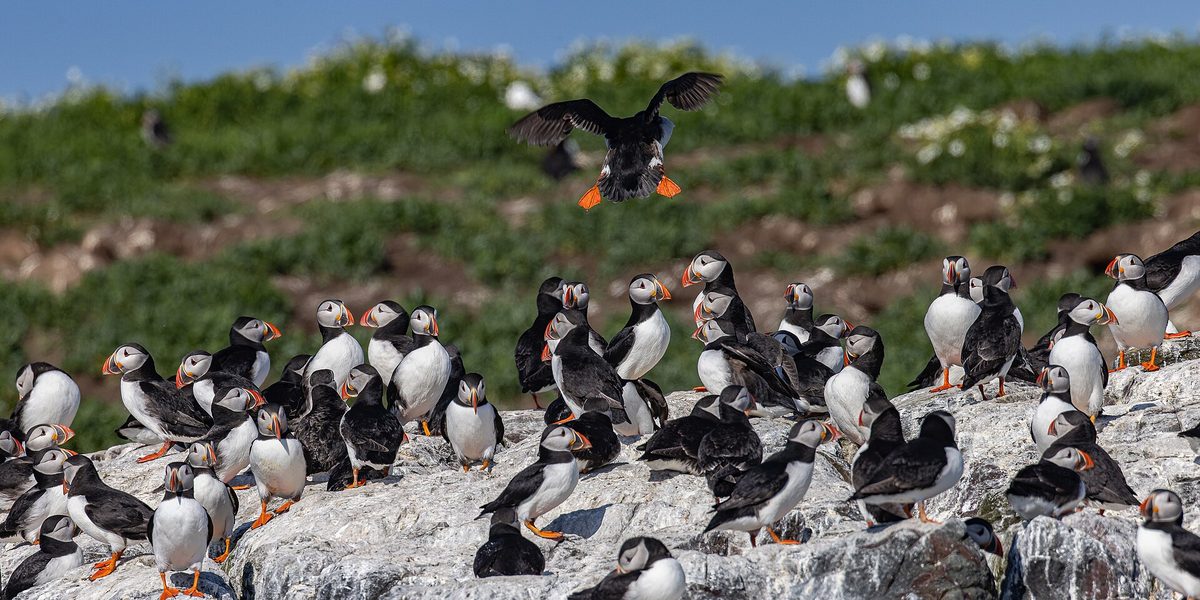
If Holy Island is about history, the Farne Islands are about wildlife — and for a few months a year they’re one of the best seabird experiences in Britain. This cluster of rocky islands a few miles offshore is owned by the National Trust and is home to grey seals year-round and, in spring and summer, vast breeding colonies of puffins, guillemots, razorbills, kittiwakes, shags, and famously aggressive Arctic terns that will dive-bomb your head (wear a hat — they aim for the highest point).
Boat trips from Seahouses
You reach the islands by boat from Seahouses harbour. Several operators run trips; the long-established name is Billy Shiel’s, run by the same family since 1918 (farne-islands.com). Trips come in two broad flavours: a sailing-around cruise where you circle the islands and see the wildlife from the boat, and a landing trip where you actually step onto Inner Farne and walk among the colonies. The landing trips are the special ones — being surrounded by thousands of puffins at arm’s length is genuinely unforgettable — but they cost more and depend on conditions and landing access.
Prices vary by operator and trip type; the cruises were the cheaper option and landing trips more, as of 2026 — book ahead in summer and check the operator’s site for current fares and the day’s sailing status, because everything is weather-dependent. Pre-booking is strongly advised; you collect tickets at the harbour office before sailing.
When to go, and an important caveat
Puffin season runs roughly April to July — the birds come ashore to breed and then leave for the open sea, so by August the puffins are largely gone (the seals stay). For the full colony, aim for May or June.
One thing to check before you build a trip around landing on the islands: access has changed in recent years. After bird-flu outbreaks hit the colonies hard in 2022–23, the National Trust closed the islands to landings, then reopened Inner Farne for visitor landings (from 1 April in 2026), while Staple Island has remained closed to landings. The seabird situation is monitored and can change season to season, so confirm current landing access with the National Trust and your boat operator before booking if walking among the puffins is the whole reason you’re coming.
The Best Beaches
This is the secret weapon of the Northumberland coast: the beaches are enormous, clean, gold-sanded, and astonishingly empty even in August. After the packed coves further south, walking onto a mile of beach with maybe ten other people on it is a small shock. These rank among the best beaches in England and underpin Northumberland’s reputation in any list of the best seaside towns in England — here’s where I’d actually go.
Bamburgh Beach is the famous one, and rightly: a vast sweep of pale sand directly beneath the castle, with the Farne Islands offshore. It’s the shot you’ve seen. Walk north and it just keeps going. There’s no shade and the North Sea is bracing, but the setting is unbeatable.
Embleton Bay is my pick for a long, quiet walk. It curves below the ruined silhouette of Dunstanburgh, and at the Low Newton end you’ve got the Ship Inn — a tiny pub that brews its own beer, almost on the sand. Beach, castle ruin, harbour pub: a near-perfect Northumberland afternoon.
Druridge Bay, at the southern end, is the big empty one — roughly seven miles of dune-backed sand with a country park and lakes behind it. It rarely feels busy because there’s simply so much of it. Good for a blowy walk and big skies.
Honourable mentions: Alnmouth, where the estuary and pastel houses make a postcard; Beadnell Bay, sheltered and good for families and watersports; and the long strand at Warkworth below the castle. There isn’t a bad beach on this coast.
Fishing Villages and Where to Eat
The working villages are part of the texture here — small harbours, real fishing boats, and food that hasn’t been gentrified into oblivion.
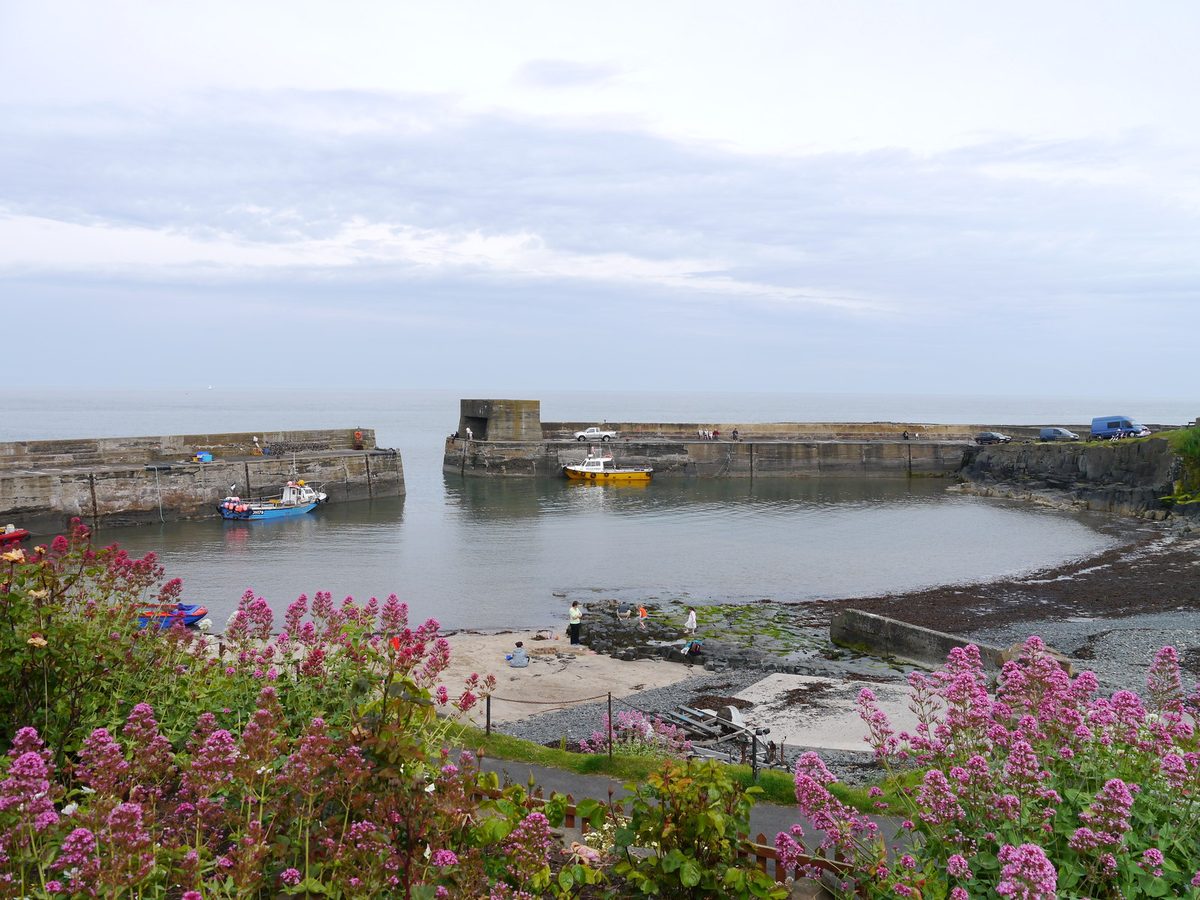
Craster is famous for one thing: kippers. L. Robson & Sons have been smoking herring over oak in the same harbourside smokehouse since the 1850s, four generations on, and Craster kippers are reckoned among the best in Britain. Buy some to take away, or sit in the village pub or the family’s own restaurant and eat them properly. They’re rich, oaky and a world away from the supermarket version — yes, they’re worth it, and yes, your car will smell of smoke afterwards. Worth it.
Seahouses is the busiest, the boat-trip hub, and the place for fish and chips — there are several good chippies near the harbour, and eating them on the harbour wall watching the boats come in is the move. It’s not the prettiest village (it’s a proper working/holiday town), but it’s the practical base for the Farnes.
Alnmouth is the prettiest, hands down — a tumble of pastel cottages on a spit between river and sea, with a couple of good pubs and a genuinely lovely setting. It’s also on the main railway line, which makes it a smart car-free base.
For the wider story on coastal pubs and village food across England, the best seaside towns in England guide covers more — up here, the rule is simple: eat the local fish, drink the local beer, and don’t expect fine dining (you won’t want it anyway).
Getting Around the Northumberland Coast
Let me be straight: this coast is much easier with a car. The villages, castles and beaches are spread out along minor roads, and the best beaches and Dunstanburgh aren’t on any bus route at all. That said, a car-free trip is very doable if you base yourself right — and the England train travel guide has the national rail context.
By train. Two stations on the East Coast Main Line serve the coast: Alnmouth in the middle and Berwick-upon-Tweed in the north. Both are on the fast London–Edinburgh line, so you can reach the coast directly from London, York, Newcastle or Edinburgh without a connection — genuinely impressive for somewhere this remote-feeling. Alnmouth is the better base of the two for the coast’s core. Note that Holy Island, the Farnes and Bamburgh do not have their own stations — you arrive at Alnmouth or Berwick and continue by bus, taxi or bike.
By bus. The X18 (Arriva) is the coastal bus and it’s a good one — frequently named among the UK’s most scenic routes. It runs roughly Newcastle–Alnwick–Seahouses–Bamburgh–Berwick along the coast, calling at Amble, Warkworth, Alnmouth, Craster (nearby), Seahouses and Bamburgh. With the X18 plus the short Alnwick–Alnmouth connection, you can string together the villages and the main castles. Check current timetables before relying on it, especially in winter when services thin out and evenings are sparse.
By car. Driving is the freedom option. Rough drive times to calibrate your day: Newcastle up to Bamburgh is around an hour and a half; Alnwick to Bamburgh maybe 30–40 minutes; Craster to Seahouses 15 minutes; Bamburgh to the Holy Island causeway about 20–25 minutes. Nothing is far — the coast is compact — but the roads are slow and single-carriageway, so don’t pack the day too tight. Village car parks (Bamburgh, Craster, Seahouses) fill on summer weekends; arrive early. This coast pairs naturally onto a wider North of England road trip or a loop down through the Yorkshire road trip country to the south.
On foot and by bike. The Northumberland Coast Path runs the length of the AONB and is mostly flat, well-waymarked walking — you can do day sections between villages using the X18 to get back. Cycling is rewarding on the quiet lanes too, though there’s no continuous traffic-free coastal cycleway.
Where to Stay
Where you base yourself depends on whether you’ve got a car and what you’re prioritising. For the national-level decision-making, where to stay in England is the parent guide — here’s the local read.
Bamburgh is the dream base if you want the castle on your doorstep and don’t mind paying for it — it’s the most desirable (and priciest) village, with a handful of inns and B&Bs. Wake up, walk the beach before the day-trippers arrive.
Seahouses is the practical middle base: more accommodation, more choice of places to eat, and you’re walking distance from the Farne Islands boats. Less charming, more convenient.
Alnmouth is the pick for a car-free trip — pretty, on the railway line, with good pubs and the X18 for the coast. Alnwick town suits castle-and-garden visitors who want shops, restaurants and a base slightly inland.
Berwick-upon-Tweed anchors the north end — a proper, characterful town with Elizabethan walls you can walk, its own station, and easy reach of Holy Island. Underrated, and good value compared with the honeypot villages.
Across the board, expect cottages, inns and B&Bs rather than big hotels, and book well ahead for summer and school holidays — the supply is genuinely limited and Bamburgh especially sells out. For families, self-catering cottages near a beach are the sweet spot up here.
Final Thoughts
I keep coming back to Northumberland for the same reason I described at the start: the scale of the place against how few people are in it. You get a castle as good as anything in the country, on a beach you can have largely to yourself, with puffins offshore and a kipper smokehouse round the corner — and it never feels crowded, even in high summer.
My one piece of real advice: respect the tide and plan around it, but don’t let it dominate your trip. Check the causeway times, pick your Holy Island window, and then spend the rest of your days doing very little on enormous beaches and walking out to ruined castles in the wind. That’s what this coast is for. Of all the corners of England, it’s the one I’m always slightly reluctant to recommend too loudly — because part of me wants to keep it this empty.
Research and Source Notes
Holy Island causeway safe crossing times are published by Northumberland County Council (holyislandcrossingtimes.northumberland.gov.uk); the June 2026 figures cited (e.g. Saturday 13 June 2026: safe 04:35–11:40, unsafe 11:40–17:05) are taken directly from the council’s official June 2026 table, which also advises allowing an extra 30 minutes for weather. Farne Islands information (National Trust ownership; Inner Farne reopened to landings from 1 April 2026 while Staple Island remained closed; grey seals year-round; puffin breeding season roughly April–July) is from the National Trust and contemporaneous reporting on the post-bird-flu reopening; boat-trip details (sailings from Seahouses harbour, Billy Shiel’s operating since 1918) are from the operator (farne-islands.com) and Visit Northumberland. Castle facts: Bamburgh is privately owned by the Armstrong family (bamburghcastle.com); Dunstanburgh is National Trust-owned and English Heritage-managed; Alnwick Castle is the Percy/Northumberland Estates seat, open roughly late March–October, with documented Harry Potter filming (alnwickcastle.com); Warkworth Castle and Hermitage is English Heritage. Lindisfarne Priory (English Heritage) and Lindisfarne Castle (National Trust) are separate sites under separate management. Craster kippers are produced by L. Robson & Sons (kipper.co.uk). Transport details (Alnmouth and Berwick-upon-Tweed stations on the East Coast Main Line; the Arriva X18 coastal bus) are from Visit Northumberland, the Northumberland Coast Path resources, and the operators. All prices are approximate and hedged as of 2026 — verify current admission, fares and opening times on official sites before you travel, and always re-check the live causeway times for your dates.
Photo Credits
- Bamburgh Castle on its crag above the empty beach, the iconic Northumberland coast guide landmark — Photo: mattbuck (category) / CC BY-SA 4.0 via Wikimedia Commons. Source
- The ruined towers of Dunstanburgh Castle on the headland near Craster — Photo: mattbuck (category) / CC BY-SA 4.0 via Wikimedia Commons. Source
- Lindisfarne Castle on its crag on Holy Island, Northumberland — Photo: Robert Eyers / CC BY-SA 4.0 via Wikimedia Commons. Source
- Puffins crowded on the cliffs of the Farne Islands off the Northumberland coast — Photo: Hansheap / CC BY-SA 4.0 via Wikimedia Commons. Source
- The small stone harbour at Craster, Northumberland, with fishing boats — Photo: James T M Towill / CC BY-SA 2.0 via Wikimedia Commons. Source
Frequently asked questions
How many days do you need on the Northumberland coast?
Three days is the sweet spot. That gives you the main castles (Bamburgh, Dunstanburgh, Alnwick), a Farne Islands boat trip, and Holy Island — with enough slack to work around the tidal causeway, which is the one thing you can't rush. One day only covers a fraction; a long weekend or more lets the coast breathe.
Can you walk to Holy Island?
You can, via the marked Pilgrims' Way across the sands — but only in daylight, ideally with someone who knows the route, and never on a rising tide. It's not the road, and the road's safe crossing times do not apply to it. Most visitors drive the causeway during the official safe window instead. Always check the times first.
When can you see puffins on the Farne Islands?
Roughly April to July, when puffins come ashore to breed. May and June are peak, with the full colony present and active. By August most puffins have left for the open sea, though grey seals are on the islands year-round. Confirm boat sailings and any landing restrictions with the operator before you go.
Which Northumberland castle is the best to visit?
Bamburgh if you want one intact, dramatic castle on a beach — it's the showstopper, though it's privately owned so no English Heritage or National Trust discount. Dunstanburgh if you love an atmospheric ruin and a coastal walk. Alnwick for families and Harry Potter fans (seasonal). They're all different; with three days you can see all three.
Do you need a car for the Northumberland coast?
It helps a lot — the beaches and Dunstanburgh aren't on bus routes. But it's doable car-free: trains stop at Alnmouth and Berwick on the main line, and the scenic X18 bus links the coastal villages and main castles. Base yourself in Alnmouth or Seahouses and you can manage without driving.
What's the nearest train station to Bamburgh?
There's no station at Bamburgh itself. The nearest mainline stations are Alnmouth (to the south) and Berwick-upon-Tweed (to the north), both on the East Coast Main Line. From either, continue to Bamburgh by the X18 bus or by taxi — roughly 30–40 minutes from Alnmouth by road.