Sheet 79 · First-Time England Planning Guide · 19 min read
England Travel Tips for First Timers
Honest England travel tips for first timers: money, contactless, transport, weather, pubs and etiquette — everything I wish I'd known before my first trip.
 Sheet 79
Contents 13 sections
The thing nobody warns you about your first trip to England is how many tiny, unspoken rules there are. Not big scary ones — small ones. How you stand on an escalator. Whether you tip the barman. Which way to look before crossing a road in Soho so a black cab doesn’t flatten you. None of it is hard, but get a few of these right early and the whole country opens up faster.
These England travel tips are the orientation I wish someone had handed me on my first flight in: how money actually works now, how to move around without overpaying, what the weather is really like, and the handful of etiquette things that make locals warm to you instead of sighing. Get these sorted and you’ll feel less like a tourist by day two.
Quick Answer: England Travel Tips Every First Timer Needs
If you remember nothing else: England uses pounds sterling (£), not euros, and you’ll tap a contactless card or phone for almost everything. Pack layers and a waterproof — the weather changes hourly. Queue, say “sorry” and “please” a lot, and stand on the right of escalators. Pubs are order-at-the-bar, no table service. That’s 80% of it.
The rest of this guide unpacks the details — caps, tipping, transport, SIMs and the etiquette that actually matters — with rough prices and times hedged for 2026. If you’re at the very start of planning, our England travel guide is the big-picture hub; this piece is the on-the-ground orientation.
At a glance: what trips up first timers
| Tip category | What to know | Common first-timer mistake |
|---|---|---|
| Money | Pounds sterling; contactless everywhere; cap around £100 per tap | Bringing euros; expecting to need much cash |
| Transport (London) | Tap in and out with one card/phone; daily cap protects you | Buying a paper Travelcard or topping up an Oyster you don’t need |
| Driving | Drive on the left; roundabouts go clockwise; speeds in mph | Renting a car for a London-only trip |
| Weather | Mild, grey, changeable; rain any month | Packing for “summer” with no waterproof |
| Tipping | ~10–15% in restaurants (often pre-added); none in pubs | Tipping twice; tipping the bartender |
| Etiquette | Queue, apologise, keep left on escalators | Standing left, jumping queues, being loud |
| Connectivity | Cheap eSIM/SIM; free Wi-Fi common | Roaming on a home plan and getting stung |
| Plugs & water | Type G plug, 230V; tap water free and safe | Buying an adapter at the airport for triple the price |
Money: it’s pounds, and it’s almost all contactless
First, the one that surprises Americans and even some Europeans: England is not in the Eurozone. The currency is the pound sterling (£), full stop. Scotland and Northern Ireland print their own banknotes that are also valid, but in England you’ll see Bank of England notes — the polymer (plastic) ones, since paper notes were withdrawn a few years back. If you’ve got old paper fivers from a previous trip, they’re no longer legal tender; a bank can usually still exchange them.
Now the genuinely useful part: you barely need cash. England went tap-to-pay hard, and it stuck. A contactless debit or credit card — or Apple Pay / Google Pay on your phone — works for coffees, museum entry, market stalls, taxis, train fares, almost everything. I carried about £40 in notes for two weeks on my last trip and came home with most of it.
There was a £100 cap on a single contactless card tap. As of 2026 the regulator (the FCA) removed the mandatory cap from 19 March, so banks can now set their own limits — but in practice most UK banks are keeping the £100 limit for now, and an FCA survey found most consumers actually wanted it kept (MoneySavingExpert). So treat around £100 per tap as the working number. Above that you’ll be asked to insert your card and enter a PIN — make sure you know yours. Phone wallets (Apple/Google Pay) have effectively no limit because they authenticate with your face or fingerprint, so for a big restaurant bill, paying by phone is smoothest.
A few money habits that save real money:
- Use a card with no foreign-transaction fees. A 2–3% fee on every tap adds up fast. Many travel-focused cards (and apps like Wise or Revolut) charge nothing and use a fair exchange rate.
- If an ATM or card machine offers to charge you “in your home currency,” always say no and choose pounds. That “dynamic currency conversion” bakes in a terrible rate. Always pay in GBP.
- Skip the airport currency kiosks. Their rates are the worst you’ll see. If you want a little cash, use a bank ATM (locals call them “cashpoints”) once you’re in town.
- Keep maybe £20–£40 in coins and small notes for the rare cash-only spot — a tiny rural pub, a church donation box, a market trader, or a public loo that charges around 30–50p.
For the full breakdown of what things actually cost — accommodation, food, transport, attractions — see our England cost guide and the deeper England budget costs page. This is just the “how to pay” part.
Tipping: lower-key than you’re used to, and watch for double-charging
Tipping in England is gentler and lower-stakes than in North America, mostly because staff are paid at least the national minimum wage — tips are a thank-you, not a wage top-up. Here’s my rough rulebook:
- Sit-down restaurants: around 10–15% for good service. But — and this is the big one — many restaurants, especially in London, automatically add a “service charge” of around 12.5% to the bill. If it’s already there, you don’t tip on top. Glance at the bottom of the bill before you reach for extra. If the service was poor, you’re within your rights to ask for the service charge to be removed.
- Pubs and bars: no tipping. You order at the bar and pay there; nobody expects a tip on a pint. If a bartender’s been brilliant, the traditional move is to say “and one for yourself” — they’ll add the price of a drink (or pocket the equivalent). That’s it.
- Cafés and counter service: optional. A tip jar might sit by the till; dropping in your change is a nice gesture, never required.
- Black cabs and minicabs: round up to the nearest pound, or add roughly 10% for a longer ride. Rounding £18.40 up to £20 is completely normal.
- Hotels: optional — maybe £1–£2 a bag for a porter, a few pounds for housekeeping if you like. Not expected.
The headline: don’t over-tip out of anxiety, and never tip twice. Locals don’t, and you won’t offend anyone by following suit. VisitLondon’s official tipping guide backs all of this up if you want a second opinion.
Getting around London: one card, tap in and out
London’s transport is one of the easiest big-city systems in the world once you understand the single golden rule: tap the same card or phone when you enter and when you exit. On the Tube and many rail journeys, the fare is calculated from where you tapped in to where you tapped out. Forget to tap out and you’ll be charged a maximum fare — a small, avoidable sting.
You do not need to buy anything special. For years the advice was “get an Oyster card,” but for most visitors now, contactless is the smart choice: same fares as Oyster, same daily and weekly caps, and no £10 (non-refundable) deposit for a physical Oyster (TfL; Finding the Universe). Just tap your bank card or phone. The one reason to still consider Oyster: if your card charges foreign-transaction fees per tap (then a single Oyster top-up is cheaper), or if you’re travelling with children who qualify for discounts.
The caps are the genius bit. As of 2026, Zones 1–2 are capped at around £8.90 a day and roughly £44.70 for a Monday–Sunday week (TfL has frozen that weekly cap until March 2027). So you tap freely all day and the system simply stops charging once you hit the cap — no need to calculate whether a day pass is “worth it.”
A few London transport notes:
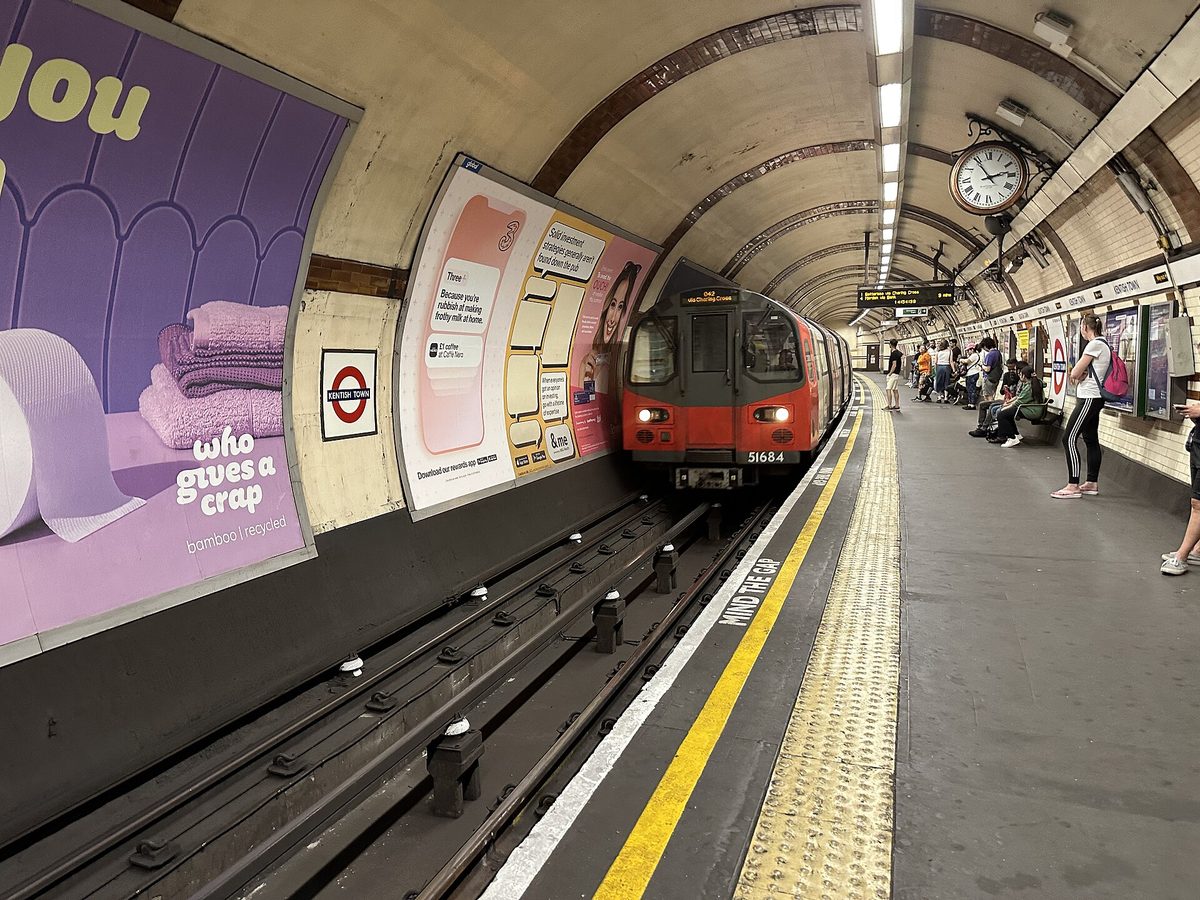
- “Mind the gap.” You’ll hear it on the platform; it’s literal. Watch the gap between train and platform edge, especially with a suitcase or a buggy.
- Stand on the right on escalators — always. The left is for people walking up. Block it and you’ll feel the collective glare.
- Buses are tap-on only (one flat fare, no need to tap off) and you can’t pay cash. Stick your arm out to flag the bus you want; drivers won’t stop otherwise.
- Black cabs vs. apps: licensed black cabs are everywhere and the drivers genuinely know the city, but Uber/Bolt are usually cheaper. Both are fine.
- Citymapper is the app locals actually use for routing. (More on apps below.)
For a proper deep dive — zones, night Tube, Heathrow into town, accessibility — see London public transport for tourists and our broader London travel guide.
Trains, intercity travel and the “book early” rule
Beyond London, England runs on trains, and this is where a little knowledge saves a lot of money. Fares are notoriously variable: the same London-to-York seat can cost £25 booked in advance or over £100 walking up on the day.
My rules for England’s railways:
- Book advance tickets early — fares typically release around 12 weeks before travel, and the cheapest “Advance” tickets sell out. If your dates are fixed, book the moment they open.
- Off-peak is much cheaper. Avoid the morning and evening commuter rushes (roughly before 09:30 and again late afternoon) and prices drop. “Off-peak” and “super off-peak” tickets are flexible within their time windows.
- Consider a railcard if you qualify (under-30s, over-60s, two people travelling together, families). A railcard costs around £30 a year and knocks roughly a third off most fares — it pays for itself in a couple of journeys.
- Use Trainline or the National Rail app to compare, but buying direct from the operator avoids small booking fees.
For the whole picture — coaches (National Express and Megabus are far cheaper for tight budgets), regional rail, and whether to drive at all — read England transport. And if trains are your whole plan, there’s a dedicated England itinerary by train route.
Driving: yes, on the left — and it clicks fast
If your trip leans rural — the Cotswolds, the Lake District, the Cornwall coast — a car unlocks places trains don’t reach. The famous worry is driving on the left. Honestly? It clicks within the first hour. Follow the car in front, take it slow, and your brain recalibrates faster than you expect.
What actually catches people out is everything around the side of the road:
- Roundabouts go clockwise. You give way to traffic coming from your right. When in doubt, wait for a clear gap and go. If you miss your exit, just loop around again — no shame in it.
- Speed limits are in miles per hour, not km/h — your hire car’s speedo will be too. Rough defaults: 30 mph in towns, 60 mph on single-carriageway country roads, 70 mph on motorways and dual carriageways (about-britain.com).
- Speed cameras are everywhere and strictly enforced. Fines and points are real, and they’ll find a hire-car driver via the rental company. Don’t chance it.
- Country lanes are narrow — sometimes single-track with “passing places.” Slow right down, and reverse to a passing place if needed. A bit of courtesy goes a long way; a wave of thanks is customary.
- Petrol/diesel is sold by the litre and is expensive by US standards. Most motorway services have fuel, but it’s pricier there.
- Don’t rent a car for a London-only trip. Congestion charges, the ULEZ emissions zone, brutal parking costs and excellent public transport make it pointless. Pick the car up as you leave the city.
If a road trip is the dream, England road trips maps out the best routes; for non-drivers, day trips from London reach a surprising amount by rail.
The weather: it’s a mindset, not a forecast
Let me reset your expectations: English weather isn’t bad, it’s changeable. You can get sun, cloud, a sharp shower and sun again in a single afternoon. Summers are mild (often high teens to mid-20s °C — that’s roughly 60s–70s °F), winters are grey and damp rather than brutally cold, and rain can show up any month. The mistake is treating any forecast as gospel.
The fix is the British mindset: dress in layers and always have a waterproof. My standing kit for England, any season:
- A light, packable rain jacket with a hood (umbrellas die instantly in city wind — a hood is more reliable).
- Layers you can add or peel — a tee, a jumper/fleece, a jacket — rather than one heavy coat.
- Genuinely comfortable, broken-in walking shoes. You will walk far more than you plan, often on cobbles and uneven pavements.
Don’t let grey skies cost you a day. Locals carry on regardless, and so should you — some of my best memories are of drizzly walks that cleared into golden light. For the season-by-season breakdown (and when crowds and prices peak), see choosing when to go, and for the complete what-to-bring list, our England packing checklist goes deep so I don’t have to here.

Pub etiquette: the heart of English social life
If you do one cultural thing in England, go to a proper pub. But there are unwritten rules, and breaking them marks you instantly as a first-timer. Here’s how it actually works:
You order at the bar. There is no table service. Walk up, wait your turn (more on that in a second), order your drinks and food, and pay there and then — usually no tab unless you’re eating a full meal. Then you carry your own drinks to a table. Gastropubs that serve proper meals sometimes do table-order food, but assume bar service unless told otherwise.
The “invisible queue” at the bar is real. It doesn’t look like a queue — people cluster around the bar — but everyone silently knows who arrived before them, and good bartenders track it too. Don’t barge in or wave money around. Make eye contact, maybe a small raised finger, and wait. If you get served out of turn, gesture to whoever was ahead of you. Patience here earns quiet respect (Debrett’s; CNN).
Rounds. If you’re drinking in a group, the custom is that one person buys a “round” for everyone, then someone else gets the next one, and so on. Don’t try to pay only for your own drink each time — it disrupts the rhythm — and when it’s clearly your turn, step up without being asked. It all evens out over an evening.
A few more pub notes: order a pint (about 568ml) or a half; ask for a “lager” or a “bitter” or a local ale if you want to fit in. Tap water is free if you ask (see below). And pubs are family-friendly until early evening in most cases, though rules on children vary by venue and time. For the full food-and-drink experience — Sunday roasts, afternoon tea, what to actually order — see England food, pubs and afternoon tea.
Everyday etiquette: queue, apologise, keep your voice down
The English are reserved, polite and deeply attached to fairness — which mostly shows up as the queue. Queuing is close to sacred. Whether it’s a bus, a coffee, a cash machine or a museum, find the back of the line and wait. Pushing in (or even appearing to) is the fastest way to irritate people. The flip side is lovely: queues are orderly and calm, and nobody jostles.
A few more things I picked up:
- “Sorry” is a social lubricant, not an admission of guilt. People say it constantly — when you bump them, when they bump you, to get past, to start a question. Join in.
- “Please” and “thank you” punctuate everything. A cheerful “thanks!” to a bus driver as you get off is normal.
- Keep the volume down on public transport and in restaurants. The English are quiet in shared spaces; a loud group stands out (not in a good way).
- Personal space matters. Don’t crowd people in a queue or on a half-empty train.
- Small talk leans to the weather and self-deprecation. Don’t take dry, deadpan humour literally — it’s affection in disguise.
- Escalators: stand right, walk left. I know I’ve said it. It’s that important.
None of this is about being stiff. It’s about being considerate, and the moment you relax into it, people are genuinely warm and helpful. If you want the broader list of slip-ups to sidestep, England travel mistakes is the companion piece, and worries about safety are covered properly in how safe England is (short version: yes, very — just mind your pockets in crowds).
Staying connected: SIMs, eSIMs and Wi-Fi
Don’t roam on your home plan and discover the bill later. Getting online in England is cheap and easy.
- eSIM (easiest): if your phone supports it (most from ~2021 onward do), buy a UK eSIM before you fly from a provider like Airalo or Holafly, or directly from a UK network. You scan a QR code and it’s live the moment you land. Plans start at just a few pounds for a chunk of data.
- Physical SIM (cheapest data): pick one up on arrival — there are shops (WHSmith, Boots, network kiosks) right in Heathrow’s terminals, plus every high street. Prepaid SIMs don’t require ID in the UK, so you can buy and activate immediately. Three and Smarty tend to have the cheapest unlimited data; EE has the best rural coverage; Vodafone and O2 are solid in cities.
- Wi-Fi is everywhere — cafés, pubs, hotels, most trains and the entire London Underground network (yes, you get signal on Tube platforms now, and increasingly in tunnels too).
For the apps that make a trip smoother — transport, maps, weather, fare-finders — see England travel apps. My short list: Citymapper for cities, the National Rail or Trainline app for trains, and Google/Apple Maps for walking.
The small stuff that quietly matters
A grab-bag of things that don’t need their own section but will save you a moment of confusion:
- Plugs are Type G — the big three-rectangular-pin design — running on 230V. Bring a UK adapter (and buy it at home, not at the airport where it costs triple). Most phone and laptop chargers handle 230V fine; check anything with a heating element.
- Tap water is safe and free. Drink it everywhere. By law, any licensed premises (pubs, restaurants, cafés serving alcohol) must give you free tap water if you ask (MoneySavingExpert). Carry a refillable bottle.
- Shop opening hours, especially Sundays. Weekdays and Saturdays, most shops run roughly 9am–6pm (later in big cities). On Sundays, large shops can only open for six hours, usually 10/11am–4/5pm (gov.uk). Small convenience shops can open longer. Plan big shopping for any day but Sunday.
- Public holidays (“bank holidays”) mean reduced hours and busier attractions; there’s a cluster in spring and another in late August.
- The emergency number is 999 (or 112). For non-urgent police, dial 101; for non-emergency medical advice, 111.
- Measurements are gloriously inconsistent. Distances and speed are in miles, beer in pints, but most other things (weather, food packaging) are metric. You’ll adjust.
- Toilets are “the loo” or “the toilets”; “restroom” will get you a puzzled look. Some public ones charge a small coin.
- Look right first when crossing roads (traffic comes from the opposite direction to North America and mainland Europe) — many London crossings even paint “LOOK RIGHT” on the tarmac for exactly this reason.
How long do you actually need, and where to go?
Quick orientation since it shapes everything else: London alone justifies 3–4 days for a first timer, and most people are happiest with 7–10 days to add a region or two. We break this down properly in how many days in England, with ready-made routes in our first-time England itinerary and a classic 7-day England itinerary.
For where, the greatest hits are well-covered in best places to visit England, and if you’re weighing cities versus countryside, the England regions map for tourists helps it click. Don’t try to see it all — England rewards going slower.
Final Thoughts
The honest truth about visiting England for the first time is that almost nothing here is difficult — it’s just different in small ways, and the differences come fast. Tap your card, pack a waterproof, queue without complaint, order at the bar, and look right before you cross. Do those five things and you’re already moving through the country like you’ve been before.
What I love about England is how much it rewards a little local fluency. Get the etiquette right and a reserved nation turns surprisingly warm — directions offered, a chat at the bar, a “you’ll be alright, love” from a stranger when you look lost. The tips above aren’t about performing Britishness; they’re about removing the friction so you can spend your energy on the good stuff: the pub on a rainy afternoon, the train pulling into a stone city, the green hills opening up past the motorway.
Now go and plan the actual trip. Start with the England guide for the master overview, sort your route with a first-time England itinerary, and don’t forget your adapter.
Research and Source Notes
I cross-checked the time-sensitive facts in this guide against official and authoritative sources, as of June 2026:
- Contactless limits: the FCA’s removal of the mandatory £100 cap (effective 19 March 2026) and banks’ decision to largely keep £100 for now, via MoneySavingExpert.
- London transport fares and caps: Transport for London’s official fare capping page, plus a 2026 Oyster-vs-contactless comparison from Finding the Universe.
- Tipping norms: the official VisitLondon tipping guide.
- Free tap water rights: MoneySavingExpert’s tap water guide, reflecting the licensing-law requirement on alcohol-serving venues.
- Sunday and shop trading hours: the UK government’s official trading hours for retailers.
- Driving rules and speed limits: about-britain.com’s visitor driving guide, consistent with Highway Code defaults.
- Pub etiquette: Debrett’s pub etiquette and CNN Travel’s guide to British pub rules.
Prices, caps and entry rules change — anything marked “around” or “as of 2026” is a guide, not a guarantee, so confirm current figures (especially the ETA and fare caps) with the official sources above before you travel.
Photo Credits
- Tower Bridge over the Thames at dusk, one of the first landmarks first-time visitors see when following England travel tips — Photo: Aleem Yousaf / CC BY-SA 2.0 via Wikimedia Commons. Source
- A classic red telephone box on a London street, an icon first-time visitors love to photograph — Photo: Doyle of London / CC BY-SA 4.0 via Wikimedia Commons. Source
- A black cab on a wet London street, the classic way first-timers picture getting around the city — Photo: Wilson’s, Havana (publisher) (CC0) via Wikimedia Commons. Source
- Honey-coloured stone cottages at Arlington Row in Bibury, the Cotswolds, a classic rural England scene — Photo: John H Darch / CC BY-SA 2.0 via Wikimedia Commons. Source
- The facade of Buckingham Palace in London, a must-see for first-time visitors to England — Photo: Diliff / CC BY-SA 3.0 via Wikimedia Commons. Source
Frequently asked questions
Do I need cash in England, or is contactless enough?
Contactless is enough for almost everything — cards and phone wallets are accepted nearly everywhere, from markets to taxis. I’d still carry around £20–£40 in small notes and coins for the rare cash-only pub, market trader, donation box or paid toilet. Use a card with no foreign-transaction fees, and always choose to pay in pounds, not your home currency.
How much should I tip in England?
Far less than in North America. In sit-down restaurants, around 10–15% — but check first, because many add a service charge of about 12.5% automatically, and you shouldn’t tip twice. In pubs and bars you don’t tip at all; if service was great, say “and one for yourself.” Round up taxi fares. Tipping is a thank-you here, never an obligation.
Is the tap water safe to drink in England?
Yes, completely. Tap water across England is treated to strict standards and is safe everywhere — drink it freely and carry a refillable bottle. By law, any venue licensed to serve alcohol must provide free tap water if you ask, so you never need to buy bottled water with a pub or restaurant meal. It also tastes perfectly fine in most regions.
What kind of plug adapter do I need for England?
England (and the whole UK) uses the Type G plug — three flat rectangular pins in a triangle — on a 230V supply. Bring a UK adapter, and buy it before you travel rather than at the airport, where they’re heavily marked up. Most modern phone and laptop chargers are dual-voltage and work fine; only worry about high-wattage items like some hair tools.
Do I need a visa or anything to enter England?
Many visitors (including US, Canadian, Australian and most European travellers) don’t need a visa for short stays, but the UK now requires an Electronic Travel Authorisation (ETA) before you fly — applied for online in advance for a small fee. Rules and prices change, so check the official guidance and our dedicated ETA page before booking.
Should I drive in England as a first timer?
Only if your plans reach rural areas like the Cotswolds, Lake District or Cornwall. Don’t drive in London — public transport is excellent and driving is a hassle. Elsewhere, driving on the left clicks within an hour, but expect narrow lanes, clockwise roundabouts, speeds in mph and strictly enforced cameras. Pick the car up as you leave the city, not before.

1 note
Notes are closed on this sheet.