Sheet 62 · England by Train and Transport · 21 min read
Driving in England for Americans
Driving in England for Americans: the left side, roundabouts, ULEZ, speed cameras, parking and first-hour nerves, with calm and specific advice.
 Sheet 62
Contents 15 sections
Here is the honest truth about driving in England for Americans: the hard part lasts about an hour. You will sit in the wrong seat, reach for a gearstick that isn’t there, flick the wipers when you meant to signal, and feel your heart rate spike at your first roundabout. Then your brain quietly rewires itself, and by lunchtime you’re singing along to the radio on a motorway. It’s learnable. This guide gets you there with your nerves intact.
I’m writing this for the person who has never driven on the left, who is slightly terrified, and who wants concrete competence rather than vague encouragement. We’ll cover the actual act of driving, the wheel in your hands and the road under your tyres, not the paperwork. (For choosing and booking a car, insurance, and pickup logistics, that’s a separate job, and I’ll point you to it.)
Quick Answer: Is driving in England for Americans actually hard?
No, not for long. Driving in England for Americans is mostly a one-hour mental adjustment to driving on the left, plus learning a handful of genuinely different things: roundabouts (give way to the right), narrow country lanes with passing places, speed limits in miles per hour with serious cameras, and London’s Congestion Charge and ULEZ. Book an automatic, use your passenger as a navigator, drive slowly at first, and you’ll be fine within a day.
If you remember only one thing, make it this: your body stays toward the centre line of the road. In your own country the centre line is on your left. In England it’s on your right. Keep yourself near it and the rest of the car falls into place.
At a glance: US habits vs. England
| Your US habit | What’s different in England | What to do |
|---|---|---|
| Drive on the right | Drive on the left; wheel on the right | Keep your body near the centre line; chant “stay left” |
| Stop signs and 4-way stops | Roundabouts everywhere | Give way to traffic from your right |
| Mostly automatics | Most rentals are manual (stick shift) | Book an automatic specifically |
| Speeds in MPH, generous limits | MPH but lower limits + cameras | 30 in town, 60 single-carriageway, 70 motorway |
| Turn signal on the left stalk | Indicator on the right, wipers on the left | Pause before turning so you don’t wipe the windscreen |
| Wide lanes, big shoulders | Narrow lanes, hedges, single-track roads | Slow down; learn passing-place etiquette |
| Free city driving | London Congestion Charge + ULEZ, other clean-air zones | Check your plate online; pay by the deadline |
| Pump color = fuel type | Colors are reversed; misfuelling is costly | Read the words: petrol vs diesel |
| Phone in hand at a light | Illegal to touch a handheld phone, ever | Mount it; set the route before you move |
Driving on the left: the crucial first hour
Let’s start where the fear lives.
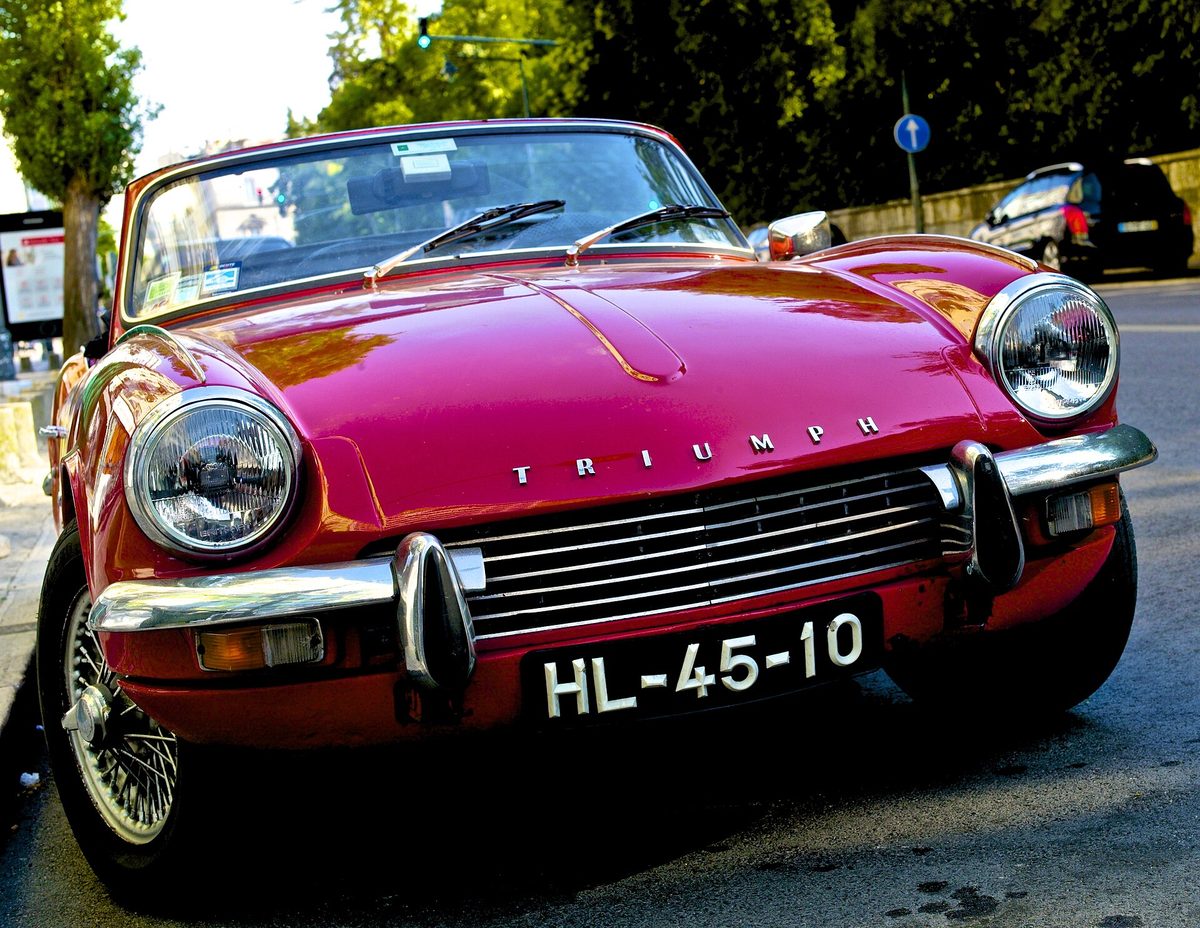
The strangeness isn’t really the road, it’s that everything is mirrored. You sit on the right. You steer with your left hand mostly. The rear-view mirror sits to your left. For the first few minutes your instincts are all backwards, and that’s completely normal. So we manage the first hour deliberately.
Do not drive straight out of the airport into a city. If you can, arrange to start your driving somewhere calmer, or at least sit in the car park for five minutes and find every control before you move: indicators, wipers, headlights, the handbrake, reverse. Adjust your mirrors. Breathe.
Use your passenger as a navigator and a left-side alarm. This is the single best trick. Your front-seat companion becomes your co-pilot: they read the sat-nav, they call out roundabout exits (“third exit, third exit”), and crucially they say “left, left, left” every time you pull out of a junction or a parking space, because pulling onto the wrong side is the classic mistake and it almost always happens after a stop. If you’re driving solo, say it out loud to yourself. It feels silly. Do it anyway.
Keep your body toward the centre line. Drift happens because you’re used to sitting on the other side of the car, so Americans tend to hug the left and clip the kerb or scrape the hedge with their nearside mirror. Aim to keep yourself, the driver, close to the centre of the road. A useful calibration: find a quiet stretch, note where the left edge of the road sits relative to your bonnet, and you’ll quickly internalize how much car is to your left.
The wipers-versus-indicator mistake is universal. In your car the turn signal stalk is on the left. In most English cars it’s on the right, and the wipers are on the left. So the first dozen times you go to signal a turn, you’ll smear the windscreen instead. Everyone does it. It’s harmless and a little funny, and within a day your hand finds the right stalk. Just take a half-second pause before any turn so you reach deliberately.
Drive consciously slowly at first. Your brain is doing a lot of background processing and it’s genuinely tiring, more than you’d expect, so keep the radio off until you settle and plan a break sooner than you think you need one. Following another car helps enormously: let them show you the lane.
English roundabouts, explained properly
Roundabouts are the thing Americans dread and then, weirdly, end up loving. They replace most of the stop signs and many of the traffic lights you’d expect, and once they click, they’re faster and less stressful than a four-way stop.
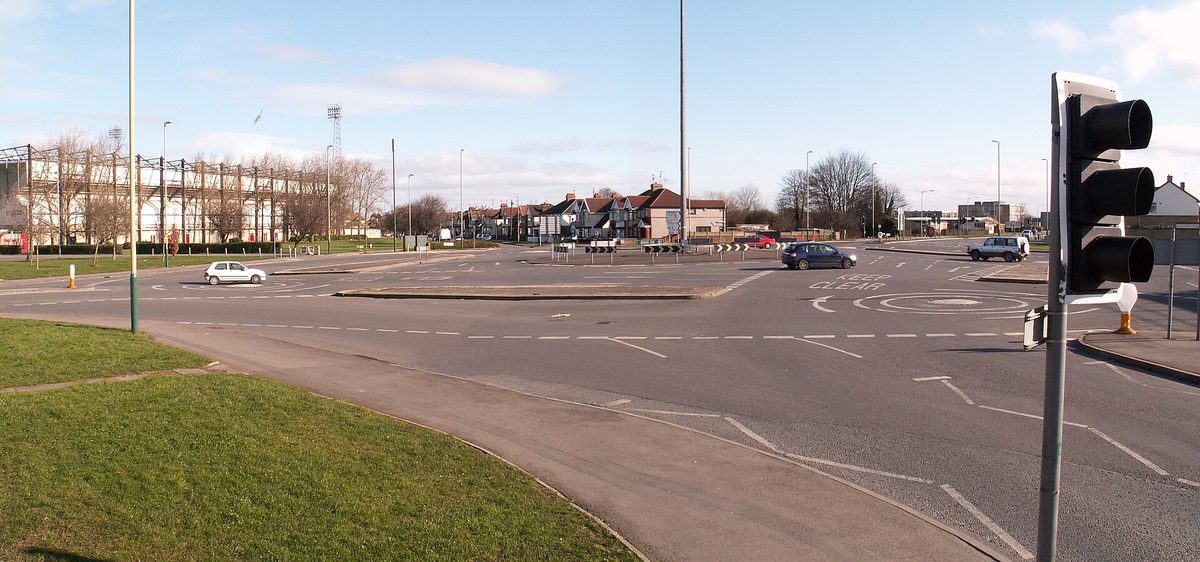
Here is the whole foundation in one line: give way to traffic coming from your right. Because you travel clockwise around the island (the opposite of an American traffic circle), the cars already on the roundabout approach you from the right, and they have priority. You wait at the line until there’s a safe gap on your right, then you go. You do not have to stop if it’s clear, you just yield.
Lane discipline is the other half, and it’s simpler than it looks. Think of the roundabout like a clock and your exit like a number:
- Taking the first exit (a “left turn,” roughly before 12 o’clock): approach in the left lane, signal left, stay left all the way around.
- Going more or less straight ahead (around 12 o’clock): usually approach in the left lane, no signal on approach, then signal left just after you pass the exit before yours. (Some big roundabouts mark a different lane, so follow the painted arrows.)
- Turning right or going most of the way around (past 12 o’clock): approach in the right lane, signal right, hold the right lane, then signal left as you pass the exit before the one you want and move out.
The cardinal rule: stay in your lane while you’re on the roundabout, and signal left as you leave so the person waiting knows you’re exiting. Don’t change lanes mid-circle, that’s where bumps happen.
Mini-roundabouts are just a painted white circle, often where two small roads meet. Same rule, give way to the right, but there’s barely any room, so it’s really about courtesy and reading who got there first.
The big multi-lane ones (you’ll meet a few on A-roads and ring roads) look intimidating with two or three lanes and overhead signs. They follow the exact same logic; there’s just more of it. The overhead or painted signs tell you which lane serves which exit, so read them on approach and commit early.
And here’s the reassurance: the first roundabout is the scary one. By the fifth, you stop thinking about it. If you genuinely panic and can’t tell where your exit is, don’t force a lane change, just stay on the roundabout and go around again. Unlike missing an exit on an interstate, going around once more costs you fifteen seconds, not fifteen minutes.
Manual vs. automatic, from the driver’s seat
I’ll keep this short because it matters so much: book an automatic. In England, the default rental is a manual (a “stick shift”), and a manual here means shifting with your left hand while you’re already juggling the left side of the road, roundabouts, and narrow lanes. The clutch is the third pedal under your left foot, and stalling on an uphill roundabout while a queue builds behind you is a special kind of stress you do not need on holiday.
Even confident stick-shift drivers find the left-handed gearstick disorienting for the first day. So unless you actively want the challenge, pay the bit extra for an automatic and give your brain one fewer thing to track. The details of availability, cost, and how to make sure you actually get an automatic belong in the booking conversation, so see booking a hire car for that.
Narrow lanes, hedgerows, and single-track roads
This is the part the brochures don’t warn you about, and honestly it’s the most charming and the most white-knuckle thing about driving here. England’s country roads are narrow.

Many lanes are bordered by tall hedgerows or stone walls right at the edge of the tarmac, so you can’t see far ahead and there’s no shoulder to bail onto. On a lot of rural roads, the posted limit is 60 mph, which is frankly absurd for the width, so treat the limit as a maximum that you’ll rarely use. Slow down, especially on blind bends, and expect a tractor, a horse, a pheasant, or an oncoming car at any moment.
Single-track roads are the real test: one lane wide, with little pull-ins called passing places every so often. The etiquette is straightforward once you know it:
- When you see an oncoming car, the driver nearer to a passing place pulls in (or reverses to one) and lets the other through. Whoever can reach a pull-in more easily yields, regardless of who arrived first.
- Because you drive on the left, pull into passing places on your left. If the only passing place is on your right, don’t cross into it. Instead, stop opposite it and let the oncoming car use it to pass you.
- Give way to traffic coming uphill where you can, and don’t expect anything large, a bus, a lorry, a farm vehicle, or anyone towing a trailer, to reverse for you. The smaller, nimbler vehicle reverses.
- Don’t park in passing places. They’re for passing, not for photos.
And the lovely bit: there’s a whole quiet language of courtesy out here. When someone pulls over for you, give them a wave or a raised hand off the wheel. When someone lets you go first, a flash of your hazards or a wave says thanks. You’ll find yourself doing it instinctively by day two, and it’s one of the small joys of driving in the English countryside. The Cotswolds and the Lake District are prime territory for this, so if that’s your route, glance at the Cotswolds Travel Guide and the Lake District Travel Guide before you go.
Motorways, A-roads and B-roads
The big roads are actually the easy part once you’ve adjusted, because they’re wide, well-signed, and predictable.
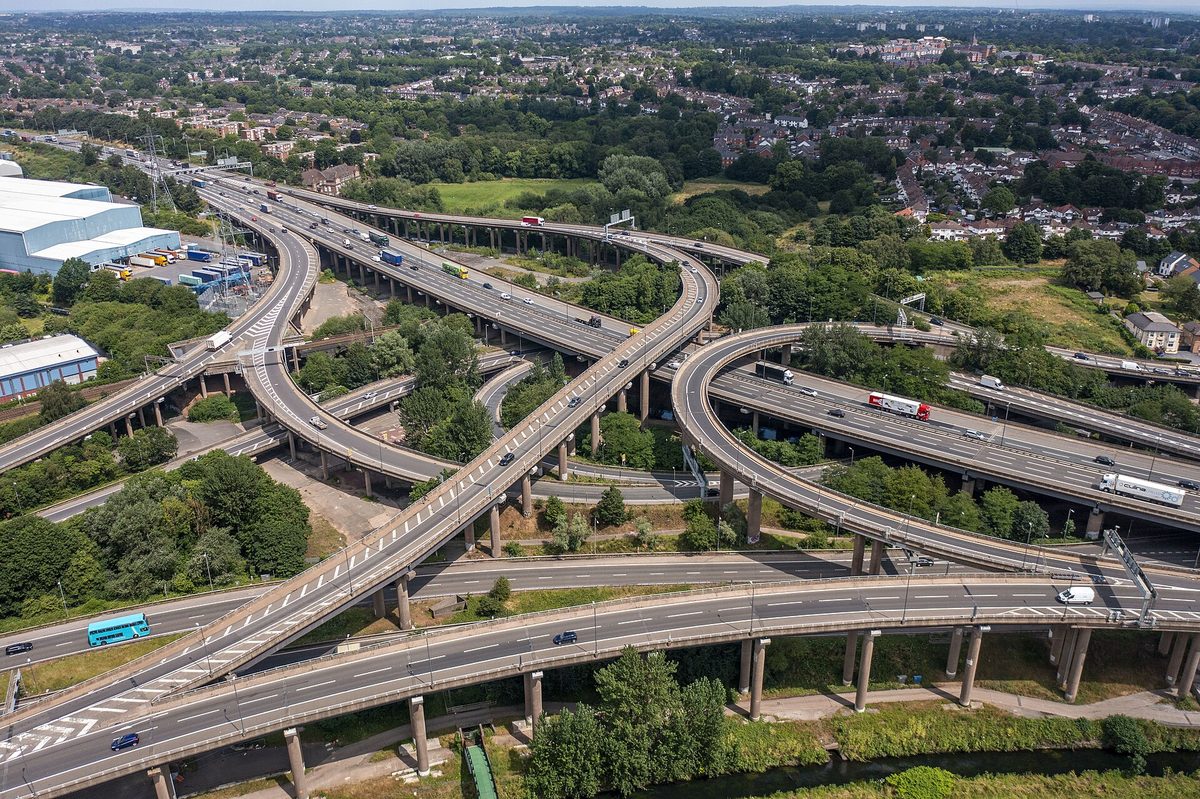
England’s road hierarchy:
- Motorways (M-roads) like the M1, M5 or M25 are the equivalent of interstates: multiple lanes, high speed, no pedestrians, no roundabouts. The blue signs are motorway signs.
- A-roads are major routes (green or white signs). Some are dual carriageways nearly as fast as motorways; others are single-carriageway two-lane roads through towns and countryside.
- B-roads are smaller, local, often scenic and slower.
The one motorway rule that surprises Americans most: keep left unless you’re overtaking. There is no “drive in whatever lane you like.” The left lane is your default; you move right only to pass, then move back. Sitting in the middle or right lane when the left is clear is genuinely frowned upon (and now an enforceable offence). Overtake on the right, never undertake on the left.
You’ll also meet smart motorways, stretches where the hard shoulder may be used as a running lane and where overhead gantry signs display variable speed limits (50, 40) and lane closures shown by a red X. Obey the gantries, a red X means that lane is closed, often because someone has broken down ahead, and driving in it is both dangerous and finable. The variable limits are enforced by camera.
Speed limits and cameras: take them seriously
Speed is measured in miles per hour, which is the one familiar thing, but the limits are lower than you’re used to and the enforcement is real. The national defaults, unless a sign says otherwise:
- 30 mph in built-up areas (street lighting is the giveaway), sometimes 20 mph near schools and in many town centres.
- 60 mph on single-carriageway roads (those narrow country lanes, remember, this is a max, not a target).
- 70 mph on dual carriageways and motorways.
Now the cameras, because England has a lot of them and they don’t care that you’re a tourist. Gatso cameras are the classic yellow boxes; they’re rear-facing and many still use a visible flash, so if you see a flash behind you, that’s why. Average-speed cameras (often around roadworks and on certain stretches) are sneakier: paired cameras read your number plate at two points and calculate your average speed between them, so you can’t just brake at the camera and speed up after, you have to keep your speed down across the whole zone. They usually don’t flash at all.
Here’s the part that stings: if you’re caught speeding in a hire car, the penalty notice goes to the rental company, who will identify you and pass on the fine plus an admin fee. From 2026, speeding penalties across the UK are tougher, so the safest, cheapest approach is simply to watch the signs and stay at or just under the limit. It’s a holiday, not a time trial.
Parking without the panic
Parking is where confident drivers suddenly feel like beginners again, mostly because the rules are signposted differently. The two big things to learn are the lines at the kerb and the payment system.
The yellow lines tell you the rules:
- Double yellow lines = no waiting or parking at any time. Don’t, even for a minute. They’re aggressively enforced and you’ll get a ticket.
- Single yellow line = restrictions apply during certain hours; check the nearby sign for the times. Outside those hours it’s usually fine.
- Red lines (mostly in London) = even stricter, no stopping at all.
To pay, you’ll meet a few systems. Pay-and-display car parks have a machine where you pay (coins or, usually, card), then put the printed ticket on your dashboard. Many councils now use apps, RingGo, PayByPhone and JustPark are the common ones, where you enter the location code printed on the sign and the bay number, then pay from your phone. Multi-storey and supermarket car parks often use automatic number-plate entry and exit, where you pay at a machine before returning to your car.
Two warnings. First, the parking apps can be fiddly for visitors: a UK SIM helps, and the official apps may not download from a US app store, so try to set one up early or keep some coins handy. Second, beware fake QR codes stuck on parking machines and signs, which send you to scam payment sites. The real RingGo doesn’t use QR codes to take payment, so type the official web address or use the app store, not a sticker.
London’s Congestion Charge and clean-air zones (ULEZ and friends)
This is the section that catches tourists out and costs them money, so read it carefully. England has several charging zones where you pay to drive certain vehicles, and they’re separate from parking and from each other.
The London Congestion Charge applies to driving in central London during charging hours. As of 2026 it’s around £18 per day if you pay in advance or on the same day (a bit more, around £21, if you pay late by the third day after). It operates Monday to Friday roughly 7am to 6pm, and weekends/bank holidays around midday to 6pm. Honestly, the easiest move is to not drive in central London at all, the London public transport network is excellent and parking is a nightmare; see the London Travel Guide for car-free strategy.
ULEZ (the Ultra Low Emission Zone) is a separate charge that covers a much larger area of London, all day, every day except Christmas. If your vehicle doesn’t meet the emissions standard, it’s around £12.50 per day. Most modern rental cars are compliant and won’t owe ULEZ, but you should never assume, check your specific number plate on the Transport for London website before you drive.
Other cities have Clean Air Zones (CAZ) too. The ones to know as of 2026: Birmingham and Bristol charge non-compliant cars (roughly £8 and £9 a day respectively), while Bath, Sheffield, Portsmouth, Bradford and Newcastle/Gateshead generally charge only buses, taxis and lorries, not private cars. Again, the trigger is whether your car meets the emissions standard, and a recent hire car usually does.
How to handle all of this without stress:
- Ask the rental company at pickup whether your specific car is ULEZ- and CAZ-compliant. Most newer ones are.
- Check the plate yourself on the official checkers, Transport for London for the Congestion Charge and ULEZ, and the GOV.UK “Drive in a Clean Air Zone” service for the other cities.
- If you do owe a charge, pay online before the deadline (you’ll need your number plate and country of registration; you don’t need an account). Miss the deadline and you get a Penalty Charge Notice, which for London can be around £180, reduced if paid quickly.
Charge amounts and zone boundaries change, so treat my figures as “as of 2026, confirm on the official site.” The penalty for guessing wrong is real money, so it’s worth the five minutes. If you’d rather sidestep the whole question, England’s trains and coaches reach almost everywhere, see travelling around England without a car.
Fuel: pump colours lie, and misfuelling is brutal
Filling up is mostly the same as home, with two traps. First, fuel is sold in litres, not gallons, and prices look small per litre but add up, so don’t panic at the per-litre number on the sign. Stations are nearly all self-serve: fill the tank, note your pump number, then pay inside at the kiosk (you generally pay after fuelling, not before).
The trap that costs real money: don’t put petrol in a diesel. Here’s the danger, in the US the pump colours you rely on are reversed in the UK, so green often means unleaded petrol and black often means diesel, which is the opposite of what your instincts expect. So ignore the colours and read the words on the nozzle: “Unleaded”/”Petrol” versus “Diesel.” Know which fuel your rental takes (it’s usually written by the fuel cap, and the rental desk will tell you), and double-check before you squeeze the trigger.
Why such a fuss? Putting petrol into a diesel engine can wreck the fuel system, and on a hire car you’re liable. If you realize you’ve done it, do not start the engine, don’t even turn the key, and call the rental company’s emergency line immediately; caught before you start the car it’s a manageable drain, but start the engine and it can run into thousands of pounds. It’s the single most expensive easy-to-avoid mistake on this list.
Signs and signals that work differently
A few things will look unfamiliar:
- Flashing headlights officially mean only one thing: “I’m here / I’ve seen you.” In practice English drivers also use a quick flash to say “go ahead, after you” at a junction or a narrow gap, a friendly courtesy. Don’t read aggression into it, and don’t flash to warn of speed cameras (technically that can land you in trouble).
- Zebra crossings are black-and-white striped crossings with no traffic lights, marked by flashing orange Belisha beacons on poles. The rule is firm: pedestrians have priority once they step onto the stripes, so you must stop. Slow down whenever you see one and someone waiting.
- Pelican and puffin crossings are the button-operated, traffic-light kind. A flashing amber light (after the red) means give way to anyone still on the crossing, then proceed if it’s clear, you don’t have to wait if no one’s there.
- Road signs lean on symbols and colour rather than words: red circles = prohibitions, red triangles = warnings, blue circles = mandatory instructions (like “keep left”). A red circle with a white bar means “no entry.” They’re quick to learn and refreshingly language-independent.
Phones and sat-nav: know the law
England’s handheld-phone law is strict and worth taking seriously. It is illegal to hold or touch a handheld phone while driving, full stop, for calls, texts, navigation, music, anything, and that includes when you’re stopped at a red light or stuck in traffic. The penalty is steep (a substantial fine and licence points for residents; for you as a visitor it can still mean a fine).
The fix is simple: mount your phone in a cradle and set your route before you move, or use the car’s built-in sat-nav, or let your passenger handle the navigating. Touchless voice commands are fine. Just keep your hands off the handset once the wheels are turning.
A simple first-hour plan
Put it all together and your first hour looks like this:
- Before moving: find every control, adjust mirrors, set the sat-nav, mount the phone, confirm whether you owe any ULEZ/CAZ charges, and take a breath.
- Pulling out: say “stay left,” and have your navigator say it too. Go slowly.
- First few miles: radio off, follow another car, keep your body toward the centre line, take roundabouts calmly (give way to the right), and resist the urge to rush.
- First roundabout: breathe, yield to the right, pick your lane, signal left as you exit. If you mess it up, go around again, no harm done.
- Build up: once you feel settled, turn the radio back on. You’ve got this.
By the end of that first hour, the strangeness fades. By the end of the day, you’ll wonder what you were so worried about. Driving here opens up an England the trains can’t reach, the hidden valley, the village pub, the coast road at golden hour. Plan where all that road actually takes you with the England road trips guide, and weave it into your wider plans via the England itinerary, the slow-travel itinerary, or our roundup of the best places to visit in England.
Final Thoughts
Driving in England for Americans is one of those things that’s far scarier in your imagination than in reality. The fundamentals, drive on the left, give way to the right at roundabouts, keep left on motorways, watch your speed, take ten minutes for ULEZ, are quick to learn, and the rest is just paying attention and slowing down. Book an automatic, lean on your navigator, and give yourself a gentle first hour.
Do that, and a self-drive trip becomes one of the best ways to see this country, the bits the railway skips, on your own schedule, with the windows down on a country lane. For the wider picture of getting around, start at our England transport hub, and if you’re still weighing it all up, our practical tips, travel mistakes to avoid and budget and costs guides will round out the plan.
Research and Source Notes
This article was researched against current page-one results and People-Also-Ask questions for “driving in England/UK for Americans,” then verified against official UK sources. Charge amounts and rules change, always confirm on the official sites before you travel.
- GOV.UK — Driving in Great Britain, speed limits, mobile phone law, and the “Drive in a Clean Air Zone” vehicle checker and guidance for Birmingham, Bristol, Bath and other CAZ cities.
- Transport for London (TfL) — Congestion Charge and ULEZ payment, hours, zones, vehicle checker and Penalty Charge Notice details (figures cited as “around” / “as of 2026”).
- The Highway Code — roundabout rules (give way to the right, lane discipline), single-track road and passing-place etiquette, pedestrian crossings (zebra/pelican/puffin), and headlight-flashing guidance.
- RAC, The AA, Auto Express, carwow and What Car? — UK speed-camera types (Gatso, average-speed/SPECS), misfuelling guidance, and pedestrian crossing explanations.
- Visitor and driver guides (Rick Steves community, Finding the Universe, and others) — first-hour adjustment tips, manual-vs-automatic reality, fuel pump colour differences, and parking-app practicalities (RingGo/PayByPhone/JustPark), cross-checked for consistency.
Figures including the Congestion Charge (~£18/day), ULEZ (~£12.50/day), Birmingham CAZ (~£8/day), Bristol CAZ (~£9/day) and the London PCN (~£180) are accurate to the best of our research as of June 2026 and should be confirmed on the official websites before driving.
Photo Credits
- Driving in England for Americans means narrow lanes, hedgerows, and traffic on the left — Photo: Rijksmuseum (CC0) via Wikimedia Commons. Source
- The right-hand-drive seat and dashboard layout American drivers will adjust to — Photo: Pedro Ribeiro Simões from Lisboa, Portugal / CC BY 2.0 via Wikimedia Commons. Source
- An aerial view of an English roundabout, the feature American drivers ask about most — Photo: Dickbauch stitched by Marku1988 This panoramic image was created with Panorama (CC0) via Wikimedia Commons. Source
- A narrow Cotswolds lane bordered by tall hedgerows, typical of rural English driving — Photo: The author is Newton2 (cropped by Yummifruitbat) / CC BY 2.5 via Wikimedia Commons. Source
- An English motorway, the wide, well-signed roads that feel familiar to American drivers — Photo: TCExplorer / CC BY-SA 2.0 via Wikimedia Commons. Source
Frequently asked questions
Is driving on the left in England hard for Americans?
It feels alarming for the first hour and then becomes second nature. Driving on the left mainly trips you up after stops (you instinctively turn onto the wrong side), so use a passenger or say “stay left” aloud. Keep your body near the centre line, drive slowly at first, and most people fully adjust within a single day.
How do English roundabouts work for a first-timer?
Give way to traffic coming from your right, then enter when there’s a gap, going clockwise. Use the left lane for early exits and the right lane for later ones, stay in your lane, and signal left as you leave. If you panic, just go around again. The first roundabout is the scary one; by the fifth you stop thinking about it.
Do tourists have to pay the London Congestion Charge and ULEZ?
Yes, the same rules apply to visitors and hire cars. The Congestion Charge (around £18/day as of 2026) covers central London on a set schedule; ULEZ (around £12.50/day) covers a wider area daily for non-compliant cars. Check your specific number plate on the Transport for London site and pay online before the deadline to avoid a penalty.
Should I rent a manual or automatic car in England?
Book an automatic. England’s default rental is a manual, which means shifting with your left hand while you’re already adjusting to the left side of the road and roundabouts. An automatic removes one big source of stress, especially when stopping uphill on a busy roundabout. See Renting a Car in England for availability and cost.
What surprises American drivers most in England?
The narrow country lanes with no shoulder, the wipers-versus-indicator mix-up, how serious speed cameras are, the “keep left unless overtaking” motorway rule, and the charging zones like ULEZ. Most surprising of all is how quickly you adapt, real fear gives way to genuine enjoyment within a day or two.
Can I use my phone for navigation while driving in England?
Only hands-free. It is illegal to hold or even touch a handheld phone while driving in England, including at red lights and in traffic. Mount your phone in a cradle and set the route before you move, use the car’s built-in sat-nav, or let a passenger navigate. Voice commands are fine; touching the handset is not.